You’ve decided to stop renting and buy your first pair of ski boots. Smart move. Rental boots are the single biggest thing holding most skiers back, and while owning may not transform your skiing overnight, a pair of properly fitting boots will certainly put you on the right track to improving as a skier.
But here’s the problem: every “best beginner ski boots” article gives you the same advice. Get something soft. Get something comfortable. Here are ten boots rated 60 to 80 flex. Good luck.
That advice isn’t wrong, exactly. It’s just incomplete. And incomplete advice is how people end up with boots they outgrow in one season, boots that cause pain they assume is normal, or boots that actively prevent them from improving.
The truth is, “beginner” is not a foot shape. A 200-pound former hockey player buying his first ski boots needs a completely different setup than a 125-pound woman who does yoga and skis one week in Colorado each winter. The flex number on the box is just one piece of a much bigger puzzle that includes your foot dimensions, your body weight, how aggressively you want to progress, and how many days you plan to ski each season.
Let’s break it down the way a bootfitter actually thinks about it.
In this guide:
- Why “Just Get a Soft Boot” Is Incomplete Advice
- How to Actually Choose Your First Boot: The Four Variables That Matter
- Boots We Recommend: Organized by Budget and Intent
- What About Custom Insoles?
- The Real Secret: Your Foot Shape Should Pick the Boot, Not the Other Way Around
- Quick Reference: Choosing Your First Boot
- Don’t Forget: Breaking in Your Boots
- Features That Actually Matter for Your First Boot
- Features You Can Safely Ignore
- What Happens When You Progress?
- Beginner Ski Boots by Budget: What $200 to $500 Actually Buys
- FAQ
Why “Just Get a Soft Boot” Is Incomplete Advice
Walk into most ski shops and tell them you’re a beginner, and you’ll get pointed toward the softest, widest, most padded boots on the shelf. The logic is simple: soft boots are comfortable, and beginners value comfort over performance.
There’s a kernel of truth here. You absolutely don’t want to start in a 130-flex race boot. But the pendulum often swings too far the other direction. Here’s what happens when you buy a boot that’s too soft:
You can’t actually learn to ski properly. Ski boots transfer your movements to the ski. If the boot flexes too easily, you never feel the ski respond to your inputs. It’s like trying to learn guitar on strings made of rubber bands. You can technically play, but you’ll never feel the notes.
You outgrow it in weeks, not years. Most beginners improve faster than they expect (especially with properly fitted boots), especially if accumulating 15+ days in a season. That ultra-soft 60-flex boot that felt perfect in December becomes a floppy noodle by March, and now you’re shopping again.
Comfort and fit are not the same thing. A boot that feels “comfortable” in the shop might have so much padding that your foot is swimming inside the shell. That extra room causes your foot to slide around, which creates blisters, pressure points, and the exact pain you were trying to avoid. Real comfort comes from a boot that holds your foot securely in the right places while giving room where you need it. (We cover this in detail in our guide on how tight ski boots should be.)
How to Actually Choose Your First Boot: The Four Variables That Matter
1. Flex: It’s About Your Body, Not Your Ability
Flex is the stiffness rating of a ski boot, measured (roughly) in a number from 60 to 130+. Lower numbers flex more easily, higher numbers are stiffer. Most beginner guides tell you to stick to the 60 to 80 range. That’s a fine starting point, but it ignores one critical factor: your body weight.
A 200-pound man in a 70-flex boot will blow right through it. The boot will fold forward with minimal effort, and he’ll feel like he’s skiing in bedroom slippers. That same 70-flex boot on a 120-pound woman might feel just right.
A better way to think about flex
- Lighter skiers (under 140 lbs): 60 to 80 flex provides enough support without fighting you. You’ll feel the ski respond without having to muscle through every turn.
- Medium build (140 to 180 lbs): 80 to 100 flex gives you room to grow. You’ll have support for progressing to parallel turns and steeper terrain without outgrowing the boot in one season.
- Heavier/athletic skiers (180+ lbs): 90 to 110 flex is more appropriate even as a beginner. Your body weight alone will compress a softer boot, leaving you with no support when you actually need it.
One important note: flex ratings aren’t standardized across brands. An 80-flex Salomon and an 80-flex Lange can feel noticeably different. This is one of many reasons why buying boots based on a spec sheet alone is risky. (More on that in our guide to buying ski boots online.)
2. Last Width: Your Foot Shape Matters More Than Your Skill Level
The “last” is the internal width of the boot at its widest point (the forefoot), measured in millimeters. Most beginner boots come in medium (100 to 102mm) or wide (103 to 106mm) lasts.
Here’s what most articles won’t tell you: a lot of beginners get pushed into wide boots because “wide equals comfortable.” But if you actually have a narrow foot, a wide boot creates dead space that lets your foot slide laterally. That causes all sorts of problems: inconsistent edge control, ankle pain from your foot rocking side to side, and blisters from the friction of movement.
The right last width depends on your actual foot width, not your skill level. And most people genuinely don’t know whether they have wide, narrow, or average feet. You might think you have wide feet because your everyday shoes feel tight, when really you’ve been wearing the wrong size for years, or you have a high instep that creates pressure across the top of your foot.
This is one of the biggest reasons we built Wayfinder’s 3D foot scanning technology. It measures your actual foot dimensions (width, length, instep height) so you’re choosing a last width based on data, not guesswork.
3. Volume: The Dimension Nobody Talks About
Width is two-dimensional, but your foot is three-dimensional. Boot “volume” describes the total internal space, accounting for the height of your instep, the depth of the toe box, and the room around your ankle.
Most boots are designed as low volume (snug all around), medium volume (the “fits most people” category), or high volume (roomier throughout). The problem is that these categories aren’t always labeled clearly. Sometimes a boot is marketed as “wide” when it’s really just “high volume,” and a wide-footed skier with a low instep ends up with too much room on top and not enough room on the sides. Volume mismatches are one of the most common reasons beginners think their boots “don’t fit.” If you’ve ever had a boot that felt tight across the top of your foot but loose around the heel, you probably had the wrong volume, not the wrong size.
4. What You Plan to Do (And How Often)
Your skiing goals and frequency should influence how much you invest.
- Once-a-year vacation skier: A well-fitted 70 to 80 flex boot in the $150 to $300 range will serve you well for several seasons. Prioritize comfort and convenience features like wider buckles and easy entry.
- 10 to 20 day per season skier: Consider spending a bit more ($300 to $500) on a boot with a higher flex (80 to 100) and a heat-moldable liner. You’ll improve faster than you expect, and a slightly stiffer boot will grow with you.
- Committed new skier (20+ days, wants to progress fast): Invest in the $400 to $600 range with a 90 to 110 flex. Get a proper fitting. Consider aftermarket insoles (they make a bigger difference than most people realize, as we explain in our liner guide). This boot should last you through intermediate and into advanced territory.
Boots We Recommend: Organized by Budget and Intent
Rather than a generic “top 10” list, here are boots organized by how you’ll actually use them. For each, we’ve included notes on fit characteristics so you can match them to your foot shape, not just your ability level.
Best Value: Under $350 (Great First Boots)
These are ideal if you ski under 10 days per year or want to try owning boots before making a bigger investment.
K2 BFC 80 (Men’s)

- Flex: 80 | Last: 103mm (wide) | Volume: High
- Price: $200 at Backcountry
- Best for: Wider feet, higher insteps, skiers who prioritize all-day comfort
- Why we like it: The BFC (Built For Comfort) line lives up to its name. The 103mm last gives generous forefoot room, and K2’s Hands Free Entry system makes getting in and out refreshingly easy. The 80 flex works well for lighter to medium-weight men or anyone not looking to charge hard. If you’re a heavier skier, consider stepping up to the BFC 100.
- Fit note: This is a genuinely wide, high-volume boot. If you have narrow feet, you’ll feel like you’re rattling around in it.
Salomon S/Pro Supra 80 GW (Women’s)
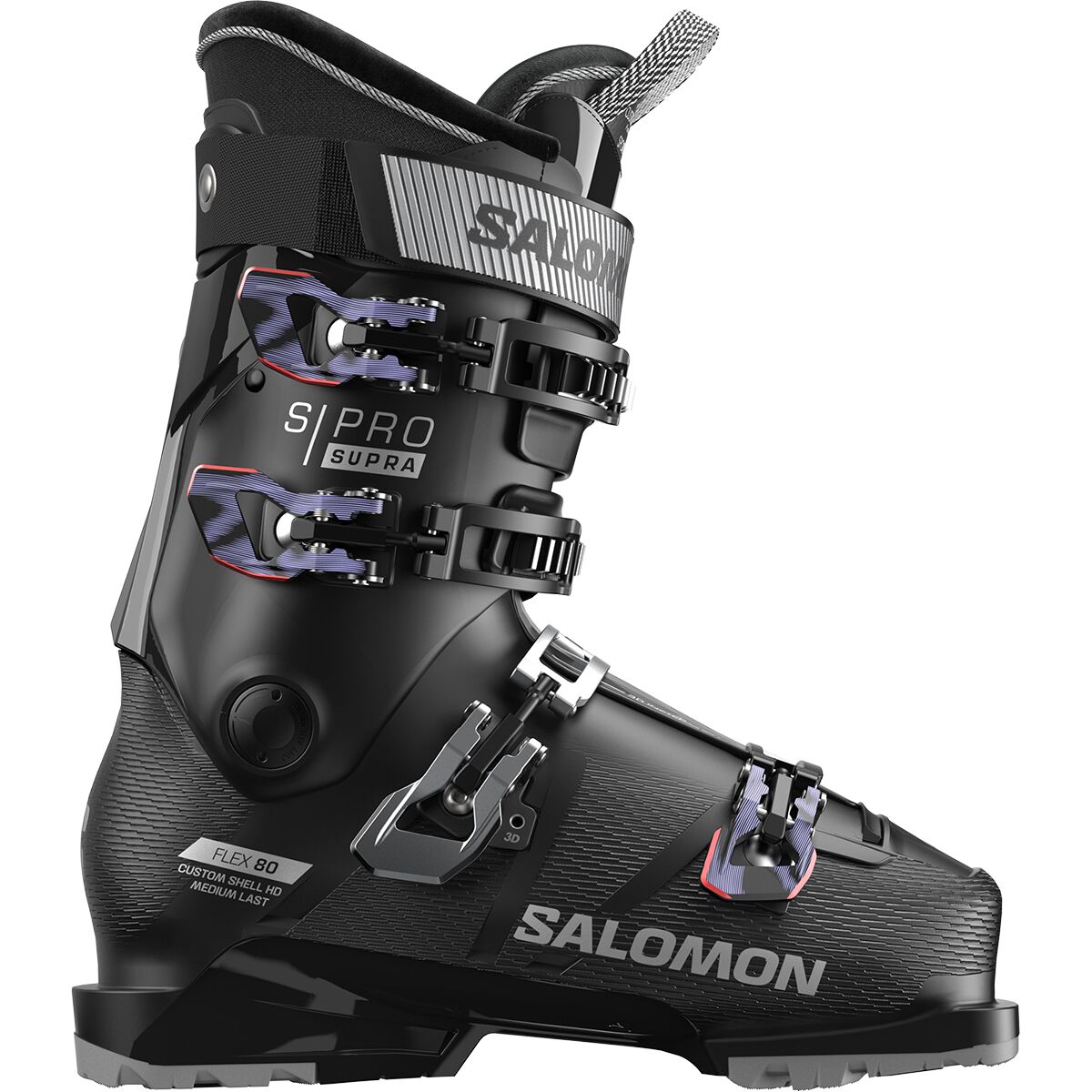
- Flex: 80 | Last: 100mm (medium) | Volume: Medium
- Price: $294 at Backcountry
- Best for: Average to narrow feet, skiers who want performance without sacrificing comfort
- Why we like it: The S/Pro line is one of Salomon’s best, and this medium-volume version hits the sweet spot for most foot shapes: a 100mm last that suits the largest share of women’s feet, a moldable liner, and a genuinely forgiving 80 flex. The women’s-specific calf adjuster is the piece most first-time buyers underrate. If the cuff pinches or gapes at your calf, nothing else about the fit will feel right. GripWalk soles come standard.
- Fit note: Medium volume through the forefoot with a fairly snug heel pocket. At 100mm this is not a wide-foot boot. If your forefoot measures past 101mm, look at the K2 BFC 75 below.
K2 BFC 75 (Women’s)
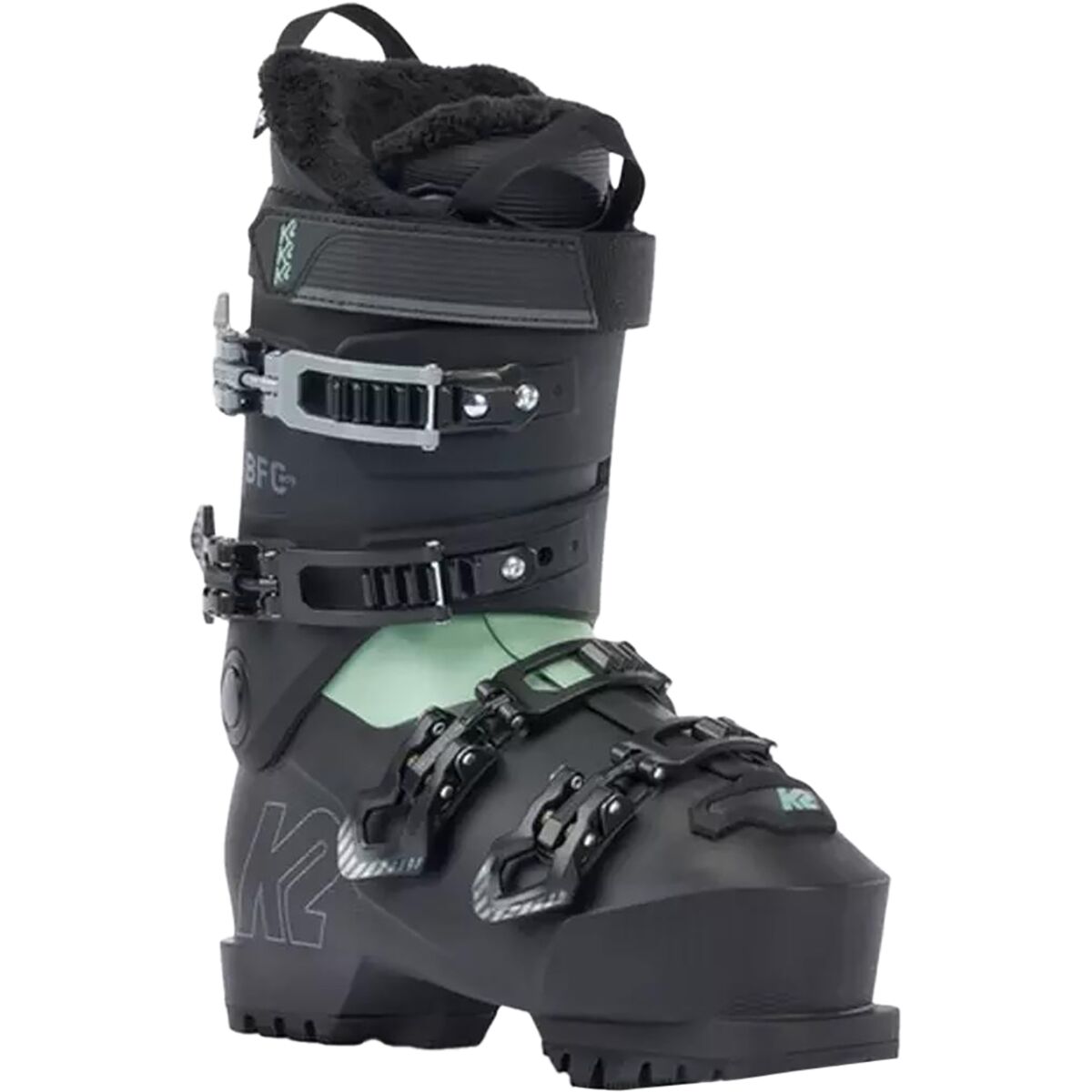
- Flex: 75 | Last: 103mm (wide) | Volume: High
- Price: $300 at Backcountry
- Best for: Wider feet with a higher instep, and anyone who dreads wrestling a boot on at the lodge
- Why we like it: BFC stands for Built For Comfort and K2 means it. The 103mm last and high-volume shell give a wide forefoot somewhere to go, the hands-free entry makes stepping in genuinely easy, and the shell is heat-moldable if one spot still needs room. At 75 flex it is soft, which is the right call for a first season.
- Fit note: This is a roomy boot. Average-width feet will swim in it. Buy it for the width, not for the discount.
Mid-Range: $200 to $450 (Boots You’ll Grow Into)
For the 10 to 20 day skier or anyone who knows they want to progress. These boots have more performance headroom and better liner quality.
Rossignol Alltrack 100 HV (Men’s)

- Flex: 100 | Last: 102mm (wide) | Volume: High
- Price: $279 at Backcountry
- Best for: Heavier/athletic beginners who want one boot that lasts through intermediate and beyond
- Why we like it: This is our pick for the athletic beginner who plans to ski regularly. The 100 flex sounds high for a beginner, but if you weigh 170+ pounds, it’s actually appropriate. The wide 102mm last accommodates bigger feet without the “bucket” feeling of some wide boots. GripWalk soles make walking in the lodge and parking lot much easier. A hike mode adds versatility if you ever want to explore sidecountry.
- Fit note: Wide and high-volume. The Alltrack also comes in a 110 and 130 if you want the same fit in a stiffer flex.
Salomon Sense 80 GW (Men’s, 2026)

- Flex: 80 | Last: 102mm (wide) | Volume: Medium-High
- Price: $370 at Backcountry
- Best for: Wide-footed beginners who want a current-year boot with modern features
- Why we like it: Brand new for 2026, the Sense line is Salomon’s comfort-focused offering. The 102mm last provides generous room, and the GripWalk sole compatibility means easy walking. As a current-year model, you’re getting the latest in shell and liner materials.
- Fit note: A wider fit from Salomon, which is notable because their S/Pro line tends to run narrower. Good for wide feet that didn’t click with the S/Pro.
Salomon S/Pro Alpha 80 W GW (Women’s, 2026)

- Flex: 80 | Last: 98mm (medium-narrow) | Volume: Low-Medium
- Price: $420 at Backcountry
- Best for: Narrow to average feet, women who want a more precise fit from day one
- Why we like it: While most beginner boots default to medium or wide, the S/Pro Alpha at 98mm caters to women with narrower feet who are tired of the “one size fits all” approach. The S/Pro line has consistently been one of the best-fitting boots on the market, and the Alpha 80 flex gives beginners plenty of forgiveness while still feeling responsive. Heat-moldable shell and liner for a customized fit.
- Fit note: This is a performance-oriented fit even at 80 flex. Not for wide feet.
Investment Tier: $450 to $600 (Buy Once, Ski for Years)
For committed beginners who plan to ski 15+ days and want a boot that grows with them from green circles to black diamonds.
K2 BFC 100 (Men’s, 2026)

- Flex: 100 | Last: 103mm (wide) | Volume: High
- Price: $350 at Backcountry
- Best for: Wide-footed skiers who want comfort AND performance, 170+ lb skiers
- Why we like it: The step up from the BFC 80, this boot keeps the same wide, comfortable fit but adds real performance with a 100 flex. For a heavier beginning skier, this is the “buy once” option. The BFC 100 will carry you comfortably from your first parallel turn to your first mogul run. Current-year 2026 model with the latest shell and liner materials.
- Fit note: Same wide, high-volume fit as the BFC 80. If the 80 felt great but a bit too soft, this is your boot.
Dalbello Veloce 100 MV (Men’s, 2026)

- Flex: 100 | Last: 100mm (medium) | Volume: Medium
- Price: $500 at Backcountry
- Best for: Average foot shapes, skiers who want a balance of comfort and precision
- Why we like it: Dalbello has earned a loyal following among bootfitters for good reason. The Veloce 100 MV provides a well-rounded medium fit with the kind of shell quality you’d expect at higher price points. Good choice for the beginner with average foot dimensions who wants a boot that transitions seamlessly into intermediate and advanced skiing.
- Fit note: True medium volume. The “Cabrio” design (two-piece shell with a separate tongue) makes entry and exit easier and provides a smooth, linear flex.
K2 BFC 95 (Women’s, 2026)

- Flex: 95 | Last: 103mm (wide) | Volume: High
- Price: $350 at Backcountry
- Best for: Women with wider feet who ski frequently and want room to progress
- Why we like it: Finding a women’s boot with a truly wide fit and higher flex is harder than it should be. The BFC 95 fills that gap with a 103mm last and a flex that’ll support progression from green circles to blue squares and beyond. The women’s-specific cuff geometry accounts for lower calf profiles without compromising the wide forefoot.
- Fit note: One of the few women’s-specific boots in a genuine wide fit at this flex level. If you have narrow feet, look at the Salomon S/Pro Alpha instead.
Salomon S/Pro Alpha 90 W GW (Women’s, 2026)

- Flex: 90 | Last: 98mm (medium-narrow) | Volume: Low-Medium
- Price: $520 at Backcountry
- Best for: Narrow-footed women who ski frequently and want precision from day one
- Why we like it: If you looked at the S/Pro Alpha 80 above and thought “I want a bit more performance headroom,” this is it. The 90 flex will carry a lighter-to-average woman from beginner through advanced. Same excellent narrow fit, heat-moldable shell, and premium liner quality. This is a boot you won’t outgrow.
- Fit note: At 98mm, this is one of the narrower women’s boots available. A great solution for women who’ve always felt their feet sliding around in “standard” women’s boots.
Rossignol Speed 80 HV+ (Men’s)

- Flex: 80 | Last: 104mm (wide) | Volume: High
- Price: $500 at Backcountry
- Best for: Larger feet, wide calves, skiers who’ve struggled with boots feeling too tight
- Why we like it: The 104mm last is one of the roomiest in the beginner category. Rossignol’s Sensor Grid technology in the shell provides decent energy transfer despite the wide fit. Good option for skiers who’ve had painful rental experiences and associate ski boots with suffering.
- Fit note: One of the widest-fitting beginner boots available. Not a good choice if your feet are average or narrow width.
What About Custom Insoles?
Here’s something most beginner guides skip entirely: the stock insoles that come in every ski boot are essentially flat pieces of foam. They provide almost no arch support, no heel cupping, and no alignment correction.
A quality aftermarket insole (typically $40 to $200 depending on whether you go off-the-shelf or full custom) transforms how a boot fits. Your heel stays locked in place, your arch is supported, and your foot sits where the boot was actually designed for it to sit. For many skiers, a good insole plus a mid-range boot outperforms an expensive boot with the stock insole.
At minimum, consider a quality off-the-shelf option.
The Real Secret: Your Foot Shape Should Pick the Boot, Not the Other Way Around
Here’s the honest truth we see as bootfitters: most beginners buy boots based on a combination of price, color, and whatever the internet says is “best.” Then they spend the season dealing with pain they assume is normal, or blaming themselves for not being a good enough skier, when the real problem is a boot that doesn’t match their foot.
Every foot is different. Your forefoot width, heel width, arch height, instep height, toe box depth, and ankle circumference all interact to determine which boot fits you and which one just sort of… doesn’t. You might read this entire article, narrow your choices down to two or three boots, and still pick the wrong one because you thought you had wide feet when your feet are actually average width with a high instep.
That’s the problem we built Wayfinder to solve. Our 3D foot scanning technology measures your actual foot dimensions from your smartphone and matches you with boots based on how they’ll actually fit your specific feet, not generic categories like “beginner” or “wide.”
You don’t need to guess. You don’t need to buy three boots and return two. And you definitely don’t need to suffer through a season in the wrong boots before figuring out what works.
Scan your feet with Wayfinder and find out exactly which boots match your foot shape before you spend a dollar.
Quick Reference: Choosing Your First Boot
If you’re a lighter skier (under 140 lbs): Look at 60 to 80 flex. The Salomon S/Pro Supra 80 GW (women’s) or K2 BFC 80 are solid starting points depending on your foot width.
If you’re average build (140 to 180 lbs): Look at 80 to 100 flex. The Salomon Sense 80 or Rossignol Alltrack 100 HV give you performance room to grow.
If you’re a larger/athletic skier (180+ lbs): Look at 90 to 110 flex. The K2 BFC 100, Dalbello Veloce 100, or Rossignol Alltrack 100 HV will support your weight properly.
If you have narrow feet: The Salomon S/Pro Alpha line (80 or 90 flex) is hard to beat. Most beginner boots are medium to wide, making narrow options harder to find.
If you have wide feet: K2 BFC and Rossignol Speed/Alltrack HV lines are among the widest. But remember, true foot width is about more than how your feet feel in shoes. If you haven’t been measured, you might be surprised.
If you’re not sure about your foot shape: That’s most people. Get scanned before you buy.
Don’t Forget: Breaking in Your Boots
Whatever you choose, know that new ski boots need a break-in period. They’ll feel firmer out of the box than they will after a few days on the mountain. The liner compresses and molds to your foot over time, so don’t panic if the first day feels snug. That’s usually a sign the boot fits correctly, not that it’s too small.
And if you’re wondering how long your new boots will last, we have you covered there too: When to Replace Your Ski Boots.
Wayfinder is a digital bootfitting service that uses 3D smartphone scanning to match your feet with the best-fitting ski boots. No more guessing, no more rental boots, no more pain. Try it free.
Your Digital Ski Bootfitter
Start your skiing with boots that actually fit.
Wayfinder matches your foot dimensions to beginner boots from top brands. Skip the shop guesswork and start with data. Free, 5 minutes, just your phone.
Start My Free FittingFeatures That Actually Matter for Your First Boot
Boot marketing leans hard on features. Most of them are noise for a first pair. These four are worth paying for.
- Heat-moldable liners. Many mid-range and better boots include liners you can heat and mold to your foot. That improves fit without touching the shell. If you do not yet know what fit problems you have, a moldable liner is insurance.
- Easy entry and exit. Wider cuff openings and overlap designs make getting your foot in and out easier. That sounds trivial until you are exhausted and fighting buckles at the end of a long day.
- Walk mode. If you will walk further than the parking lot to the lift, a lever that releases the cuff makes a real difference. Standard on touring boots, and increasingly common on resort boots.
- Buckle count. Four buckles give you more adjustment. Three are simpler to use and often plenty for a first pair.
Features You Can Safely Ignore
- Racing last width. You do not need a 97mm race last unless you are actually racing.
- 130+ flex. No beginner benefits from a boot that stiff. Plenty of skiers never do.
- Tech inserts. Skip these unless you are heading into the backcountry soon, or a touring-capable boot happens to be your best fit anyway.
- Heated liners. Nice to have, not necessary. Get the fit right first.
What Happens When You Progress?
Beginner boots do not become worthless when your skiing improves. Plenty of intermediate skiers are perfectly happy on boots they bought as beginners. You outgrow a boot when you start generating forces its flex cannot control, usually once you are skiing fast on steep terrain and driving aggressive turns.
Some skiers reach that point in two seasons. Some never do. A recreational skier who enjoys groomed blues and the occasional black may never need more than a 100 flex, no matter how many years they ski.
And when you do move up, the old pair still earns its place as your warm-up boots, your teaching-a-friend boots, or your spring slush boots.
Beginner Ski Boots by Budget: What $200 to $500 Actually Buys
Here is a price-first view of the most common picks: Prices below were checked against live retail stock on 21 August 2026; closeout pricing especially moves fast, so treat them as a snapshot.
Under $200: play the closeout game
At full retail there is almost nothing under $200 worth owning, because boots built to hit that price cut costs in the liner, and the liner is where comfort lives. The move at this tier is last season’s good boot at closeout. A live example: the 2025 K2 BFC 80 is currently listed at $200, down from $500, in exactly two sizes. That is the whole closeout game in one listing: the same 103mm high-volume boot it was at full price, but a size lottery. When your size shows up at half off, buy it that week. Skip no-name marketplace boots and retired rental fleets; a packed-out rental liner means the most important part of the boot is already used up.
$250 to $350: the value sweet spot
This is where I point most beginners, and current-season stock in this range is strong right now:
| Boot | Price (Jul 2026) | Best for |
|---|---|---|
| Atomic Hawx Prime 100 | $294 | Average-width feet, room to progress |
| Atomic Hawx Prime 85 (women’s) | $294 | Progressing women skiers, medium fit |
| Salomon S/Pro Supra 80 GW (women’s) | $294 | Forgiving 80 flex without a sloppy fit |
| K2 BFC 75 (2025, women’s) | $300 | Wide feet and high insteps |
| Rossignol Alltrack Pro 80 GW (women’s) | $325 | Wider feet, walk-friendly |
| K2 BFC 100 / BFC 95 (women’s) | $350 | Wide feet that still want support |
$350 to $500: when stepping up makes sense
The extra money buys BOA lower shells that wrap the forefoot instead of clamping it (the K2 BFC 100 BOA at $385 and Salomon S/Pro Supra BOA 85 at $364 are the beginner-relevant examples), stronger shell plastic, and better liners. Worth it if you expect to ski 15 or more days a season or have a high instep that hates buckle pressure. Not worth it to “grow into” a stiff flex; see the flex guidance above.
Two budget rules that outrank every price: never size up for comfort (here is how boots should fit), and shortlist by last width before you compare prices. And keep $50 to $80 back for a supportive footbed; it improves fit more than the next boot tier up would.
FAQ
It depends on your body weight more than your ability. Lighter skiers under 140 pounds do well in 60 to 80 flex, medium builds from 140 to 180 pounds should look at 80 to 100, and heavier or athletic skiers over 180 pounds are better served by 90 to 110 even as beginners, because body weight alone will fold a softer boot. Flex ratings also are not standardized across brands, so treat the number as a guide, not gospel.
The K2 BFC line and Rossignol’s wide models are the standouts. The K2 BFC 80 has a 103mm last with high volume, the Rossignol Speed 80 HV+ runs a roomy 104mm, and the Rossignol Alltrack 100 HV pairs a 102mm last with a flex suited to heavier beginners. For women, the K2 BFC 95 is one of the few genuinely wide women’s boots at a progression-friendly flex. Just confirm you actually have wide feet before buying wide.
Yes, but they are harder to find because most beginner boots default to medium or wide. The Salomon S/Pro Alpha line is the standout: the Alpha 80 W and Alpha 90 W run a 98mm last with a heat-moldable shell and liner, giving narrow-footed skiers a precise fit from day one. If you have always felt your feet sliding around in standard boots, a narrower last solves the problem a wide comfort boot only makes worse.
No, that advice is incomplete. A boot that is too soft never lets you feel the ski respond to your inputs, so you cannot actually learn proper technique, and most beginners outgrow an ultra-soft boot within a season. Comfort and fit are also not the same thing: a heavily padded boot can let your foot swim inside the shell, which creates blisters and pressure points. Real comfort comes from a boot that holds your foot securely in the right places.
For skiers logging under 10 days a season, the value tier makes sense: the K2 BFC 80 for wider feet and higher insteps, the Salomon S/Pro Supra 80 GW for women with average to narrow feet, and the K2 BFC 75 for women with wider feet. A well-fitted 70 to 80 flex boot from this group will serve a once-a-year vacation skier for several seasons.
If you plan to ski 15 or more days a season, yes. Boots like the K2 BFC 100, Dalbello Veloce 100 MV, and Salomon S/Pro Alpha 90 W have enough performance headroom to carry you from your first parallel turns well into advanced terrain, so you buy once instead of shopping again next spring. If you only ski a handful of days a year, skip the investment tier; a softer boot will serve you fine.
It depends on why they are cheap. A $200 closeout of last season’s $500 boot is the same boot it was a year ago and an excellent buy. A boot designed to retail at $200 almost always cuts costs in the liner, which is exactly where comfort and warmth come from. Judge the boot by its original model and price, not the sticker in front of you.
Yes, and they are usually the best value in skiing. Boot models change slowly, so last season’s version is often nearly identical to the current one at 40 to 60% off. The trade-off is size availability: closeouts sell through common sizes first, so when your size appears at a strong discount, buy it promptly.