
You’ve taken lessons. You’re done renting. You’re ready to buy your first pair of ski boots. And suddenly you’re staring at a wall of plastic torture devices with numbers like “90 flex” and “100mm last” that mean absolutely nothing to you.
Here’s the reassuring truth: buying beginner ski boots is actually simpler than the industry makes it seem. You don’t need the stiffest boot, the most advanced features, or the highest price tag. You need something that fits your feet, flexes appropriately for your skill level, and won’t make you hate skiing.
In this guide:
- Why Boots Matter More Than Skis
- The Flex Rating: What Beginners Actually Need
- Sizing: Why Ski Boots Don’t Match Your Street Shoes
- Last Width: Not Just a Pro Concern
- Features That Matter for Beginners
- Features That Don’t Matter for Beginners
- Beginner-Friendly Boots Worth Considering
- The Fit Problem: Why Buying Boots Is Hard
- How Much Should Beginners Spend?
- What Happens When You Progress?
- Getting the Fit Right
- Key Takeaways
- Related Reading
Why Boots Matter More Than Skis
If you’re going to invest in one piece of ski equipment, make it boots. You can adapt to different skis relatively easily, but poor-fitting boots will ruin every run regardless of what’s strapped to them.
Your boots are the interface between your body and your skis. Every movement you make transfers through them. When boots fit well, you feel connected to your skis and can make precise movements. When boots fit poorly, you’re fighting the equipment instead of learning the sport.
This is why rental boots feel so terrible: they’re designed to fit everyone, which means they fit no one particularly well. The day you switch to properly fitted boots is often the day skiing finally clicks.
The Flex Rating: What Beginners Actually Need
Every ski boot has a flex rating, a number that indicates how much resistance the boot provides when you push forward. Lower numbers mean softer, easier-to-flex boots. Higher numbers mean stiffer, more demanding boots.
For beginners, the sweet spot is typically 60 to 90 flex. Here’s what that means in practice:
A 60 to 70 flex works well for brand-new skiers, lighter skiers, and anyone who wants maximum comfort over performance. These boots bend easily, making it simpler to initiate turns and maintain balance while learning.
A 80 to 90 flex suits progressing beginners, heavier skiers, and those who already feel stable on blue runs. These boots provide more feedback and energy transfer while remaining forgiving enough to learn in.
The common mistake: buying too stiff. Beginners often think stiffer equals better, or that they’ll “grow into” a 110 flex boot. In reality, boots that are too stiff make learning harder. You’ll struggle to flex forward into proper position, your movements will feel delayed, and you’ll develop bad habits compensating for equipment that fights you.
Sizing: Why Ski Boots Don’t Match Your Street Shoes
Ski boot sizing uses the Mondo Point system, which measures your foot length in centimeters. A size 27.5 boot is designed for a foot that’s 27.5cm long. Simple in theory, complicated in practice.
The issue: your street shoe size is essentially meaningless. Shoe sizing varies wildly between brands and styles. Your size 10 Nike might be longer, shorter, or the same as your size 10 dress shoe, and neither tells you what Mondo size you need.
To find your Mondo size, trace your foot on paper (standing, with weight on it) and measure from heel to longest toe in centimeters. That measurement is your starting point for Mondo sizing. Most beginners should size very close to their actual foot length, perhaps a half size up for comfort. Performance skiers often size down for a tighter fit, but beginners rarely benefit from that trade-off.
The fit you’re looking for: your toes should lightly brush the front of the boot when standing straight. When you flex forward (like you would when skiing), your toes should pull back slightly and no longer touch. Your heel should feel locked in place without painful pressure. Your instep and forefoot should feel snug but not crushed.
Last Width: Not Just a Pro Concern
The last (measured in millimeters) indicates the boot’s internal width across the forefoot. This matters for beginners too, not just racers.
Narrow lasts (97mm to 99mm) suit feet that are thin across the ball of the foot. These provide more precision but can crush wider feet. Medium lasts (100mm to 101mm) fit the broadest range of foot shapes and are what most beginner boots offer. Wide lasts (102mm+) accommodate wider feet without the squeezing sensation that makes beginners want to remove their boots at lunch.
If your feet are noticeably wide or noticeably narrow, factor this into your search. A beginner boot with the right flex but wrong width will still hurt.
Features That Matter for Beginners
Heat-moldable liners: Many mid-range and up boots include liners that can be heated and molded to your foot shape. This customization dramatically improves fit without shell modifications. For beginners who may not know exactly what fit problems they have yet, a moldable liner provides insurance.
Easy entry and exit: Some boots have wider cuff openings or overlap designs that make getting your foot in and out easier. This might seem trivial until you’re exhausted and fighting with buckles at the end of a long day.
Walk mode: If you’ll be walking more than the distance from the parking lot to the lift, a walk mode lever that releases the cuff makes life significantly easier. This is standard on touring boots but increasingly available on resort boots too.
Four-buckle vs. three-buckle: Four buckles provide more adjustment options but add complexity. Three-buckle designs are simpler to use and often sufficient for beginner needs.
Features That Don’t Matter for Beginners
Racing last width: You don’t need a 97mm race boot unless you’re actually racing.
130+ flex: No beginner benefits from boots this stiff. Some skiers never need a boot this stiff.
Tech inserts: Unless you’re immediately planning backcountry touring, you don’t need frame or tech binding compatibility, unless a boot that’s backcountry capable is the best fit and meets all of your other needs.
Heated liners: Nice to have, not necessary. Get the fit right first.
Beginner-Friendly Boots Worth Considering
Atomic Hawx Prime 95 ($249.98 on sale)
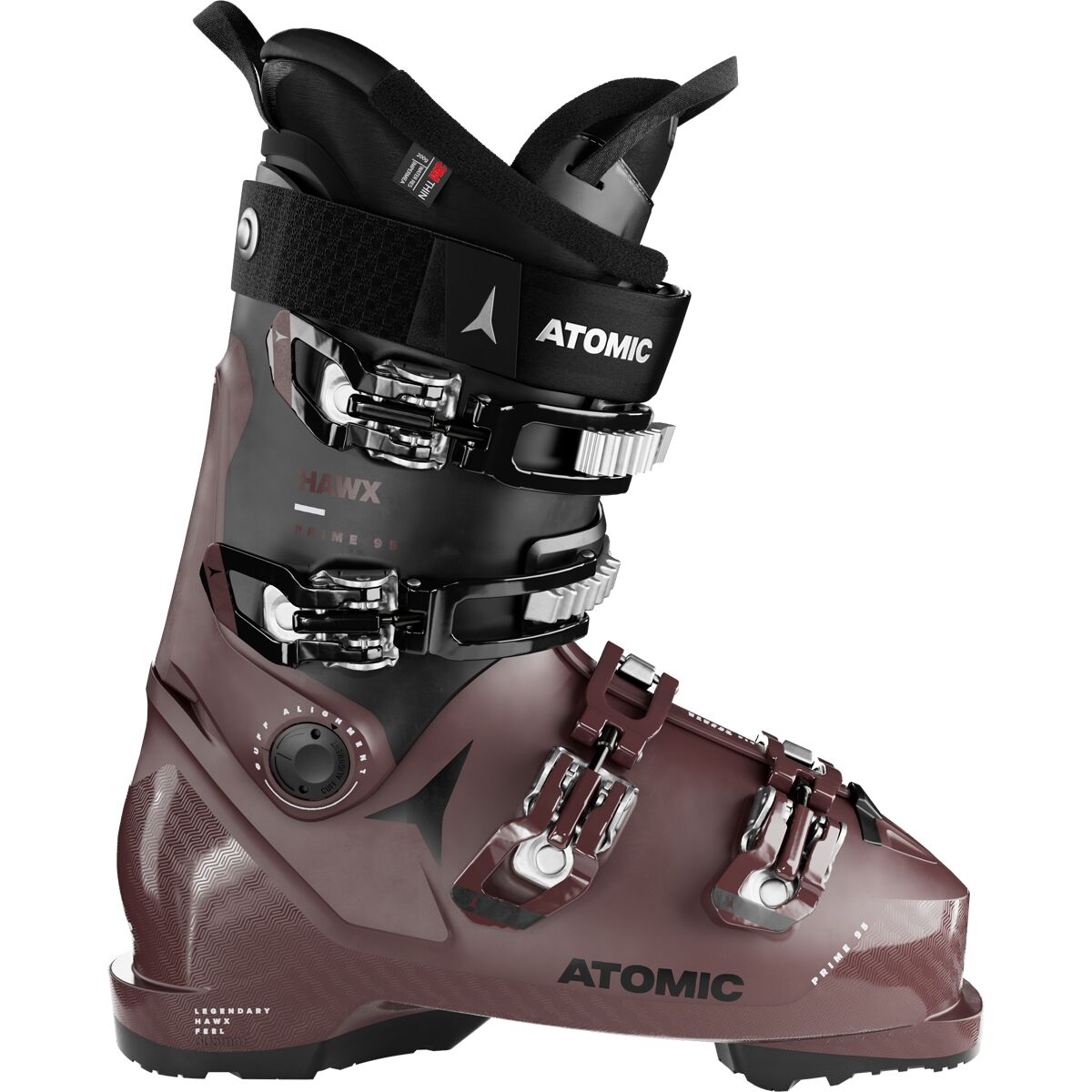
The Hawx Prime line offers a comfortable 100mm last with a 95 flex that’s approachable without being mushy. The Mimic Gold liner heat-molds for a customized fit, which is valuable when you’re still figuring out what “good fit” means.
Why it works for beginners: The 95 flex is manageable for learning while providing enough response to grow into. The 100mm last fits average feet well. The heat-moldable liner accommodates minor fit issues without shell work.
Rossignol Hi-Sp Pro Heat MV GW ($299.98 on sale)

A 100mm last with a forgiving 100 flex, plus Bluetooth-controlled heated liners. The heated feature addresses the cold feet that plague many beginners who aren’t generating enough body heat from aggressive skiing yet.
Why it works for beginners: The medium volume construction fits a wide range of foot shapes. The 100 flex is approachable but has room to grow. Heated liners mean cold feet don’t cut your ski day short.
The Fit Problem: Why Buying Boots Is Hard
Here’s the challenge every beginner faces: you don’t know what good fit feels like. First-time boot buyers have no reference point. Everything feels “tight” compared to street shoes. Everything feels “stiff” compared to sneakers.
This is why ski shops have bootfitters: experienced eyes that can assess your foot, put you in several options, and evaluate what’s actually happening inside the shell. A good bootfitter catches problems you wouldn’t notice until 20 runs later.
But not every beginner has access to a quality bootfitter. Rural areas, limited travel budgets, and time constraints mean plenty of people are buying boots online with only reviews and size charts to guide them.
Technology helps here. Wayfinder’s foot scanning captures the measurements that determine fit: not just length, but width, volume, and shape. Those measurements translate into specific boot recommendations rather than generic size charts. It’s not a replacement for hands-on bootfitting, but it’s significantly better than guessing based on street shoe size.
How Much Should Beginners Spend?
The honest answer: less than you think. High-end boots ($500+) offer features and precision that beginners can’t utilize yet. The responsiveness difference between a $600 boot and a $350 boot won’t matter when you’re still learning to link turns.
The $250 to $400 range typically provides:
- Decent liner quality with heat-moldable options
- Appropriate flex range for beginners (80 to 100)
- Medium last width that fits most feet
- Four-buckle construction for adjustment
Spending more doesn’t improve your skiing at this stage. Spending less often means compromising on liner quality, which affects comfort more than anything else.
What Happens When You Progress?
Beginner boots don’t become worthless when your skills improve. Many intermediate skiers ski happily on boots originally purchased as beginners. The boot “outgrew” threshold happens when you start generating forces that your soft-flex boot can’t control, usually when you’re skiing fast on steep terrain and initiating aggressive turns.
Some skiers reach that point in two seasons. Some never do. The recreational skier who enjoys groomed blues and occasional blacks might never need more than a 100 flex boot, regardless of how many years they ski.
When you do need stiffer boots, your beginner boots still have value. They become your warm-up boots, your teaching-a-friend boots, or your spring-slush-day boots.
Getting the Fit Right
Whether you’re buying in a shop or online, getting the fit right matters more than brand, features, or price. A mediocre boot that fits well will outperform an expensive boot that doesn’t.
For in-shop purchases, work with a bootfitter if one is available. Try multiple boots. Walk around the shop. Flex forward like you’re skiing. Ask questions about what you’re feeling.
For online purchases, know your measurements. Use a brand’s size chart as a starting point. Understand the return policy. Consider using a fitting service like Wayfinder to get personalized recommendations based on your actual foot dimensions rather than guessing.
The goal is simple: find boots that let you focus on learning to ski, not on managing foot pain.
Key Takeaways
For beginners, prioritize fit and appropriate flex (60 to 90) over features and price. Your Mondo size is your foot length in centimeters, not your street shoe size. Heat-moldable liners provide valuable fit customization for new skiers. Spending $250 to $400 gets you everything beginners need. Boots that are too stiff make learning harder, not easier.
Your Digital Ski Bootfitter
Start your ski journey with boots that actually fit.
Wayfinder uses 3D foot scanning to match beginners to boots that fit from day one. No appointment, no overwhelm. Free, 5 minutes.
Start My Free FittingRelated Reading
- Ski Boot Last Width Explained
- Best Ski Boots 2025/2026
- Ski Boot Mondo Sizing Guide
- Complete Anatomy of a Ski Boot
- How Tight Should Ski Boots Be?
- Ski Boot Mondo Sizing Chart & Calculator
- What Is Ski Boot Flex and Why It Actually Matters
- How to Break In New Ski Boots
FAQ
Less than you think. High-end boots offer features and precision that beginners cannot use yet, and the responsiveness difference will not matter while you are still learning to link turns. Mid-range boots typically get you decent heat-moldable liners, an appropriate 80 to 100 flex, a medium last width that fits most feet, and four-buckle construction. Spending more does not improve your skiing at this stage; spending much less usually means compromising liner quality, which affects comfort most.
No, buying too stiff is the classic beginner mistake. Boots that are too stiff make learning harder: you struggle to flex forward into proper position, your movements feel delayed, and you develop bad habits compensating for equipment that fights you. The sweet spot for most beginners is 60 to 90 flex, with 60 to 70 for brand-new or lighter skiers and 80 to 90 for progressing beginners and heavier skiers. Nobody benefits from growing into a 110 flex.
Ski boots use the Mondo Point system, which is simply your foot length in centimeters, so a 27.5 boot fits a foot 27.5cm long. Your street shoe size is essentially meaningless, because shoe sizing varies wildly between brands and styles. Trace your foot on paper while standing with weight on it, measure heel to longest toe in centimeters, and use that as your starting point. Most beginners should size close to their actual foot length, perhaps a half size up.
Snug, secure, and nowhere near painful. Your toes should lightly brush the front of the boot when standing straight, then pull back slightly when you flex forward into a skiing stance. Your heel should feel locked in place without painful pressure, and your instep and forefoot should feel snug but not crushed. Everything feels tight compared to street shoes at first, which is why first-time buyers often misjudge fit; that snugness is usually a good sign.
Yes. If you invest in one piece of ski equipment, make it boots. You can adapt to different skis relatively easily, but poorly fitting boots ruin every run regardless of what is strapped to them, because boots are the interface that transfers every movement you make to the ski. This is also why rental boots feel terrible: they are designed to fit everyone, which means they fit no one particularly well.
Not necessarily. Many intermediate skiers happily keep boots they bought as beginners, and a recreational skier who enjoys groomed blues might never need more than a 100 flex. The real threshold arrives when you generate forces your soft boot cannot control, usually skiing fast on steep terrain with aggressive turns. Some skiers hit that point in two seasons; some never do. When you do upgrade, the old pair makes fine warm-up or spring-slush boots.