
The ski boot world is experiencing its biggest shake-up in years. From revolutionary dual BOA technology to hybrid cabrio designs, here’s everything you need to know about this season’s most exciting ski boots, and how to find the right one for you AND your feet.
The 2025/2026 ski season is shaping up to be the most exciting season for ski boots in years. If you’ve been waiting to upgrade your setup, this is a great year to do it. Boot manufacturers have moved beyond incremental updates. We’re seeing genuinely innovative designs that prioritize both performance and comfort in ways that weren’t possible even a few years ago.
The theme this season is clear: better fit, more customization, and downhill power without sacrificing all-day comfort. Whether you’re a hard-charging expert, a park-focused freestyler, or an intermediate skier looking for your first performance boot, there’s something genuinely new and worth trying.
Let’s break down the boots that have us most excited, and help you understand which features matter most for your skiing style.
Table of contents
- The Dual BOA Revolution: A New Standard in Ski Boot Fitting
- Armada AR ONE: The Most Anticipated Boot Launch of the Season
- Lange Shadow: Redefining the Two-Piece Overlap Boot
- The Return of the Three-Piece Boot: Modern Cabrio Designs
- Understanding Ski Boot Fit: Volume, Last Width, and What Actually Matters
- Boot Recommendations by Skier Type
- The Bottom Line: Why 2025/2026 Is the Year to Upgrade
- Frequently Asked Questions
The Dual BOA Revolution: A New Standard in Ski Boot Fitting
Dual BOA ski boots use two independent dials instead of traditional buckles: one controlling the lower shell around the foot and another managing the upper cuff around the lower leg. This lets skiers micro-adjust pressure independently in each zone, even while wearing gloves, and distributes pressure more evenly than buckles to reduce hot spots. Nearly every major brand now offers dual BOA models for the 2025/2026 season.
How it works: Dual BOA boots feature two independent dials: one controlling the lower shell around your foot, the other managing the upper cuff around your lower leg. This setup lets you fine-tune fit on the fly, adjusting pressure independently where you need it most.
Why it matters: Traditional buckle boots require removing your gloves and considerable force to make mid-day adjustments. BOA dials let you micro-adjust with a quick twist, even while wearing gloves. More importantly, the cable-based closure distributes pressure more evenly than buckles, reducing hot spots and improving overall comfort.
All that being said, most of the boots featuring Dual BOA this season still have traditional 4-buckle versions and Single BOA versions for sale. I’d bet most manufacturers work to simplify their boot lineups and tooling spend by doubling down on distinct BOA and non-BOA models in the years ahead.
Top Dual BOA Boots for 2025/2026
Atomic Hawx Ultra Dual BOA (130 & 100 flex)

Atomic has been at the forefront of BOA integration, and their Hawx Ultra Dual BOA represents the fullest expression of this technology to date. Built on Atomic’s proven 98mm low-volume last, this boot features independent dials on both the cuff and shell, giving skiers unprecedented ability to fine-tune fit.
Testers report improved flex feel from the BOA cuff compared to traditional buckle setups, thanks to a single coil, dual pulley design that delivers smooth, progressive resistance. The Hawx Ultra has always been known for precision, and now it’s got the adjustability to match.
Best for: Advanced to expert skiers with narrower feet who want locked-in precision with on-the-fly adjustability.
Head Kaliber 130 MV BOA2
Head’s biggest boot project in recent memory, the Kaliber represents a complete rethinking of their all-mountain lineup. This boot features a bi-injected construction that uses stiffer plastic along the spine for power transfer and softer plastic over the forefoot for comfort and better BOA wrapping.
The 100mm medium-volume last hits a sweet spot for most skiers, while the graphene-woven liner helps regulate temperature throughout the day. Testers praised the progressive flex that delivers power without being punishing, and the out-of-box fit that’s precise without being aggressive.
Head nailed the integration here: the Kaliber isn’t a traditional boot with BOA tacked on; it’s engineered from the ground up around the technology.
Best for: Intermediate to expert all-mountain skiers seeking the balance between precision and all-day comfort.

Salomon brings their S/Pro platform into the dual BOA era with predictably excellent results. The Supra maintains the S/Pro’s reputation for consistent, reliable fit while adding the micro-adjustability that makes modern BOA boots so appealing. Available in 130 flex, 120 flex, and 105 flex for women.
Best for: Skiers already familiar with S/Pro fit who want the convenience and precision of dual BOA closure.
Check My Width →
Armada AR ONE: The Most Anticipated Boot Launch of the Season
The Armada AR ONE is Armada’s first-ever ski boot, launched for the 2025/2026 season after more than two decades of making skis. It uses a hybrid shell design combining cabrio-style tongue flexibility with traditional overlap construction, plus a unique Slingshot cable-based ankle buckle for exceptional heel retention. Available in flex ratings from 90 to 130, with tech toe inserts on the 130 model for touring compatibility.
Armada AR ONE, available in 90, 100, 110, 120, and 130 flex.

What makes it different: The AR ONE uses a hybrid shell design that takes a cabrio-style tongue and overlaps it with TPU in the forefoot and upper cuff. The result is a boot that offers the easy entry of a three-piece boot without the linear, sluggish flex that can affect high-speed performance.
The standout feature is Armada’s Slingshot ankle buckle, a unique cable-based system that locks the heel firmly in place while distributing pressure evenly across the instep. Testers consistently noted the exceptional heel retention, which was one of Armada’s primary design goals.
Available in flex ratings from 90 to 130, with the 130 model featuring tech toe inserts for compatibility with hybrid touring bindings. The boot shares some DNA with the Atomic Hawx Prime (Armada is part of the Amer Sports family), but the fit and flex feel distinctly different.
Best for: Freeride and freestyle skiers who want a boot that handles both high-speed terrain and park laps with equal confidence.
Lange Shadow: Redefining the Two-Piece Overlap Boot
The Lange Shadow replaces the traditional riveted cuff-to-shell connection with a Suspension Blade Dual Pivot system that amplifies skier input into the ski. Lange claims up to 26% more power transfer with less effort, and testers report the boot requires noticeably less flexion to initiate turns compared to traditional overlap boots. Available in LV (97mm), MV (100mm), and HV (102mm) lasts.
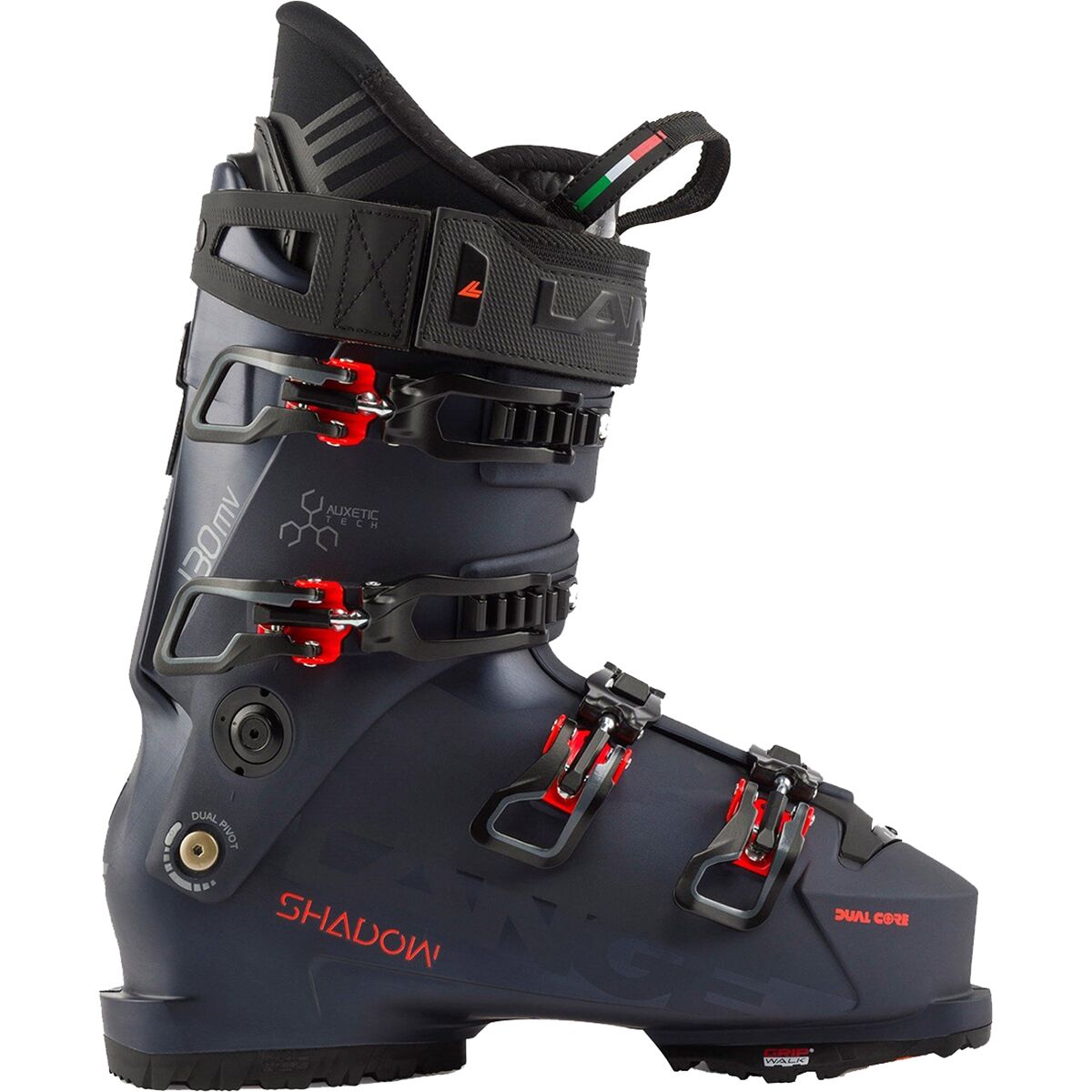
The technology: Lange replaced the traditional riveted connection between cuff and shell with their Suspension Blade Dual Pivot system. Without getting too deep into the physics, this design amplifies your input into the ski. Lange claims up to 26% more power transfer with less effort, and while that’s a marketing number, the on-snow feel is undeniable.
What it means in practice: The Shadow requires less flexion to initiate turns. Where a traditional 130-flex boot might require significant shin pressure to engage the ski, the Shadow responds to subtle inputs. This translates to less fatigue over a full day and more precise control in variable conditions.
The trade-off is an adjustment period. Several testers reported overturning initially as they calibrated to the boot’s responsiveness. Once dialed in, though, the Shadow offers a level of precision that’s converting longtime skeptics.
Available volumes:
- Shadow LV (97mm) for narrow, low-volume feet
- Shadow MV (100mm) for average feet, the sweet spot for most skiers
- Shadow HV (102mm) for wider, high-volume feet
- Shadow 115 MV Women’s for women seeking the same technology
Best for: Expert skiers who prioritize performance and are willing to invest time adapting to a new flex feel.
The Return of the Three-Piece Boot: Modern Cabrio Designs
Three-piece or cabrio boots have traditionally been the domain of park skiers and those prioritizing ease-of-entry over downhill performance. This season sees several boots challenging that stereotype with hybrid designs that blend three-piece convenience with overlap-level power.
K2 Cortex 130 LV

K2’s Cortex brings their Zonal BOA system to a true low-volume platform. The dual-dial setup controls shell and cuff independently, while the narrower 98mm last delivers the precision that serious skiers demand.
What sets the Cortex apart is its genuine low-volume fit. Many boots marketed as “narrow-lasted” have crept toward roomier profiles over the years. The Cortex bucks this trend with a fit that testers described as truly aggressive. Combined with a reliable 130 flex and excellent lateral stability, it’s a compelling option for performance-oriented skiers with narrow feet.
Best for: Expert skiers with low-volume feet who want modern BOA convenience without sacrificing fit precision.
Dalbello Il Moro

A freestyle classic that remains one of the highest-performing three-piece boots dedicated to freeskiing. Dalbello has moved the Il Moro to a more voluminous last in recent seasons, which makes it fit a broader range of feet while maintaining its trademark progressive flex.
Best for: Park and freestyle-focused skiers who want the smooth flex of a three-piece with genuine performance.
phaenom FS 01 120
A newcomer to the market, phaenom (backed by Faction Skis’ parent company) offers a hybrid cabrio design built around sustainability: 30% recycled plastic and recycled materials in buckles and liners. The 102mm last with excellent heel retention bridges the gap between overlap precision and three-piece comfort.
Best for: Freeride and freestyle skiers interested in sustainable gear without performance compromises.
Understanding Ski Boot Fit: Volume, Last Width, and What Actually Matters
All the technology in the 2025/2026 boot lineup won’t help if the boot doesn’t fit your foot. Last width (the boot’s internal forefoot measurement in mm) is the starting point, but instep height, heel pocket depth, calf volume, and toe box shape also determine fit. Two boots with identical 100mm lasts can feel completely different because of these other dimensions, which is why 3D foot scanning provides more accurate matching than size charts alone.
Last Width Explained
Last width is the measurement across the widest part of the boot’s forefoot, expressed in millimeters:
- Low volume (96-98mm): For narrow feet with low insteps. These boots fit snugly and prioritize precision.
- Medium volume (99-101mm): The most common category, designed for “average” feet. Significant variety exists within this range.
- High volume (102mm+): For wider feet, square toe profiles, or taller insteps.
Read more about ski boot lasts here.
Beyond Width: Other Fit Factors
Last width is just the starting point. Other critical dimensions include:
- Instep height: How much room exists over the top of your foot
- Heel pocket depth: How well the boot locks your heel in place
- Calf volume: How the upper cuff fits your lower leg
- Toe box shape: Pointed vs. squared-off
Two boots with identical 100mm lasts can fit completely differently depending on these other factors.
Why Your Foot’s 3D Shape Matters
Traditional boot sizing focuses on length and width, but feet are three-dimensional, and that third dimension often determines whether a boot feels perfect or painful.
This is where modern foot scanning technology becomes invaluable. By capturing the complete 3D profile of your foot, including arch height, instep volume, heel shape, and toe configuration, digital bootfitting tools can match you with boots that accommodate your specific anatomy.
Wayfinder’s foot scanning technology represents the cutting edge of this approach. Using just your smartphone, Wayfinder captures a detailed 3D model of your feet and matches you with boots that actually fit your individual shape, not just your length and width. This is particularly valuable when shopping online, where you can’t physically try on multiple boots. Instead of guessing based on size charts, you get recommendations based on how your feet actually compare to each boot’s internal shape.
Get started with your fit here.
Boot Recommendations by Skier Type
For All-Mountain Chargers
If you’re skiing everything the mountain offers (groomers, bumps, trees, the occasional hike-to line), prioritize:
- Stiff to moderate flex (115-130 for experts, 100-115 for advanced)
- Medium volume for versatility
- Dual BOA for on-mountain adjustability
Top picks: Head Kaliber 130 MV BOA2, Lange Shadow 130 MV, Nordica Speedmachine 3 BOA 120
For Freeride and Big Mountain Skiers
Powder days, steep terrain, and variable conditions demand boots with power transfer and forgiveness:
- True stiff flex (120-130)
- Progressive flex patterns that absorb impacts
- Compatibility with hybrid touring bindings is a plus
Top picks: Atomic Hawx Ultra 130, K2 Cortex 130 LV, Armada AR ONE 130 MV
For Park and Freestyle
Park skiing requires quick flex response, impact absorption, and often a softer overall flex:
- Moderate flex (100-120) for easier landings
- Three-piece or hybrid designs for progressive flex
- Lower weight for maneuverability
Top picks: Armada AR ONE 110/120 MV, Dalbello Il Moro, phaenom FS 01 120
For Intermediate Skiers Ready to Progress
Your first performance boot should prioritize comfort without being sloppy:
- Moderate flex (90-110)
- Medium to high volume for forgiveness
- Heat-moldable liners for customization
Top picks: Nordica Speedmachine 3 BOA 110, Head Kaliber 100 MV BOA, Tecnica Mach1 MV 120
The Bottom Line: Why 2025/2026 Is the Year to Upgrade
This season’s ski boots represent a genuine step forward in design. Dual BOA technology has matured from gimmick to legitimate performance feature. Hybrid cabrio designs are challenging assumptions about three-piece boots. And established categories like the overlap boot are seeing innovation (hello, Lange Shadow) for the first time in years.
If you’ve been nursing old boots that don’t quite fit or perform the way you want, this is the season to make a change.
The most important thing is finding a boot that actually fits your foot. All the technology in the world won’t compensate for a boot that’s too narrow in the forefoot or creates pressure points on your ankle bones. This is where Wayfinder’s digital bootfitting technology can make a real difference. By understanding your foot’s complete 3D shape before you buy, you’re far more likely to end up with a boot that works from day one.
Whether you go with the precision of the Lange Shadow, the adjustability of a dual BOA system, or the hybrid innovation of the Armada AR ONE, get the fit right first. Everything else follows from there.
Your Digital Ski Bootfitter
Great boots mean nothing if they don’t fit your feet.
Every boot on this list is available through our Fit Match engine. Scan your feet and get matched to the ones that work for your foot shape.
✓ 5 minutes
✓ Just your phone
✓ Millimeter accuracy
Frequently Asked Questions
For wide feet, the top 2025/2026 options include the Nordica Sportmachine 3 (102mm last), Atomic Hawx Ultra (102mm), K2 BFC (103mm), and Lange Shadow HV (102mm with the new Suspension Blade technology). Look for boots with lasts of 101mm or wider, and remember that last width scales with boot size: a “102mm” boot may be wider or narrower depending on your Mondo size. For more details on boots for wide feet, see a post here.
Dual BOA ski boots have matured from a convenience gimmick to a legitimate performance feature in 2025/2026. They allow micro-adjustments with gloved hands, distribute pressure more evenly than buckles, and let you independently tune the shell and cuff. The main trade-off is that BOA cables can occasionally break (replacement parts are widely available). Most major brands now offer BOA versions of their top models. We unpack more in a post here.
Flex depends on your weight, ability level, and skiing style. General guidelines: beginners 60-90, intermediate 90-110, advanced 110-130, expert 130+. Lighter skiers should choose softer flexes; heavier skiers may want to go stiffer. See more here.
Trace your foot and measure the widest point. Under 95mm typically indicates low volume, 95-102mm medium, over 102mm high. However, instep height and heel width also matter. This is where 3D foot scanning provides more accurate guidance than simple measurements.
Modern BOA systems are highly reliable. The cables and dials are designed for ski boot use and come with solid warranties. That said, cables can occasionally break. Replacement parts are widely available, and many skiers carry a spare cable in their pack for backcountry use.
Very. Even a well-fitting boot benefits from heat-molding to customize the liner to your specific foot shape. Most shops offer this service, and it typically takes about 15-20 minutes. See more about liners here.
Yes, especially with accurate foot scanning. The challenge has always been fit uncertainty, but with detailed 3D measurements of your feet matched against known boot dimensions, online purchasing becomes much more reliable. Look for retailers with good return policies so you can exchange if needed.

Bruce Botsford is a certified bootfitter and the founder of Wayfinder, a digital bootfitting company using 3D foot scanning technology to help skiers find properly fitting boots online. Before launching Wayfinder, Bruce spent over a decade in operations and supply chain roles at Coca-Cola, Apple, and autonomous vehicle companies including Cruise and Aurora. He holds an MBA in Operations Management from Northwestern’s Kellogg School of Management and a BA from the University of Virginia. Bruce founded Wayfinder after experiencing firsthand how difficult it is to find well-fitting ski boots without access to an expert bootfitter, and he’s on a mission to make great boot fit accessible to every skier.