You’re standing in a ski shop (or scrolling a product page at midnight, no judgment) and you see the same boot model offered in three different versions. One has four traditional buckles. One has a BOA dial on the lower shell with two buckles up top. And one has two BOA dials and zero buckles.
They’re all within $50 of each other. They all say “100mm last” on the spec sheet.
Which one do you actually buy?
If that question makes your head spin, you’re not alone. BOA closures have gone from a curiosity on a couple of boots to showing up across every major brand’s lineup in the span of about two seasons. Salomon, Atomic, K2, Head, Nordica, Tecnica, Fischer, Dalbello. In fact, as manufacturers try to establish an opinion on where consumer sentiment stands on BOA, they’re producing more buckle/BOA variants than ever, even across the same exact base boot model.
Perhaps the trickiest part for most skiers is that the marketing copy makes it sound like BOA fixes everything.
Here’s the thing: BOA does change how a ski boot fits your foot. I was skeptical until I actually tried BOA boots for the first time, but do actually believe there is some truth to the marketing angle. In some genuinely useful ways. But it’s not magic, it’s not for everyone, and the differences between a single BOA and a dual BOA setup are way more significant than most people realize.
As someone who thinks about boot fit for a living, I want to break down what’s actually happening inside these boots, which configuration solves which fit problems, and how to figure out the right one for your feet.
In this guide:
- How Do Traditional Buckles Actually Work (and Where Do They Fall Short)?
- What Does BOA Actually Do Differently?
- The Four Configurations (and Why They’re Not Interchangeable)
- The Bootfitter’s Honest Take: What BOA Changes About Fit
- Which Configuration Fits YOUR Feet?
- Here’s the Problem with Choosing from Spec Sheets
- So, Is BOA Worth It?
How Do Traditional Buckles Actually Work (and Where Do They Fall Short)?
Before we talk about what BOA changes, it helps to understand what buckles are actually doing.
A traditional four-buckle ski boot gives you four independent tension zones: lower forefoot, upper forefoot/instep, lower cuff, and upper cuff. Each buckle creates downward pressure at a single fixed point. Think of it like pressing your thumb down on the top of your foot. The force concentrates at the buckle contact point and radiates outward from there.
This system has worked for decades, and for good reason. Four independent buckles mean four independent adjustments. You can crank the instep tight for heel lock while leaving the toe buckle loose for circulation. You can tighten the cuff for power transfer without affecting the forefoot at all.
That independent zone control is why racers still overwhelmingly prefer buckles. They want to dial each zone separately, and they want it to feel exactly the same every single run.
The four buckles are also undeniably stout. Once engaged, these four (typically) aluminum alloy buckles don’t slip, flex, stretch, etc… They enhance the structural integrity of the system
So where do buckles struggle?
Pressure distribution. A buckle pushes down from above at one or two contact points per zone. If you have a high instep (and a surprising number of skiers do), cranking the instep buckle to secure your heel means crushing the top of your foot.
You get that deep aching pain across the bridge of your foot after an hour of skiing, and loosening the buckle enough to relieve it means your heel starts lifting. It’s a trade-off that buckles, by their physics, can’t fully solve.
The other issue is consistency. Buckle positions are fixed by the bail (that metal wire). You’re choosing between notches, and the difference between “one click too loose” and “one click too tight” can be significant. There’s no easy infinite adjustment in between.
None of this means buckles are bad. For many skiers (and most foot shapes), a four-buckle boot remains the best option. But understanding where buckles create compromises helps explain why BOA exists in the first place.
What Does BOA Actually Do Differently?
The BOA Fit System (specifically the H+i1 model used in ski boots) replaces one or more buckle zones with a stainless steel cable routed through multiple guide points on the shell. You turn a dial, the cable tightens, and the shell wraps inward from multiple directions simultaneously.
Here’s the key difference: instead of pushing down from one point, the cable pulls inward from five or more contact points distributed across the shell. The physics shift from “downward clamp” to “360-degree wrap.” Again, at first I was a major skeptic of this angle, but am increasingly convinced of the validity of “wrap vs. compress” benefit.
What does that actually feel like? The pressure spreads out. Instead of feeling a buckle bearing down on the top of your instep, you feel the entire shell closing around your foot more evenly.
BOA’s own testing (published in Frontiers in Sports and Active Living) found a 13% reduction in peak foot pressure compared to traditional buckles. Their internal data also claims a 6% improvement in power transfer and about 10% better stability in carved turns.
Those numbers sound impressive, and I think the pressure distribution claim holds up in practice. The power transfer and stability claims are harder to isolate from other variables, but the directional trend makes sense: a boot that wraps evenly transmits force more consistently than one with pressure concentrated at four points. There is also a real likelihood that if a skier is feeling more even pressure, and thus slightly more comfortable, they may be more likely to unleash their inner beast than if experiencing pressure and pain. Less distraction + more confidence = more send.
The other major difference is micro-adjustability. A BOA dial operates on a 4:1 gear ratio with 1mm increments per click. No notches, no “in between” frustrations.
You can make tiny adjustments in either direction with gloves on, mid-run, standing in a lift line. That’s a genuine convenience improvement over fumbling with cold buckle bails.
The Four Configurations (and Why They’re Not Interchangeable)
This is where most articles on BOA ski boots fall short. They treat “BOA boot” as one category. It’s not. There are four distinct closure configurations on the market right now, and each one changes the fit equation differently.
Configuration 1: Traditional Four-Buckle
The baseline. Four aluminum or magnesium buckles, four independent zones, maximum zone-by-zone control. Still the standard for race boots and most expert-level all-mountain boots.
Best for: Skiers or racers who need repeatable settings, skiers with “average” foot shapes that don’t create specific pressure problems with buckles, skiers comfortable with decades-proven mechanical closures.

Example: Lange Shadow 130 LV/MV/HV (shown), Nordica Dobermann GP, Tecnica Mach1, Rossignol Hero.
Price range: $400 to $900 depending on performance tier.
Configuration 2: BOA Lower Shell + Buckle Cuff
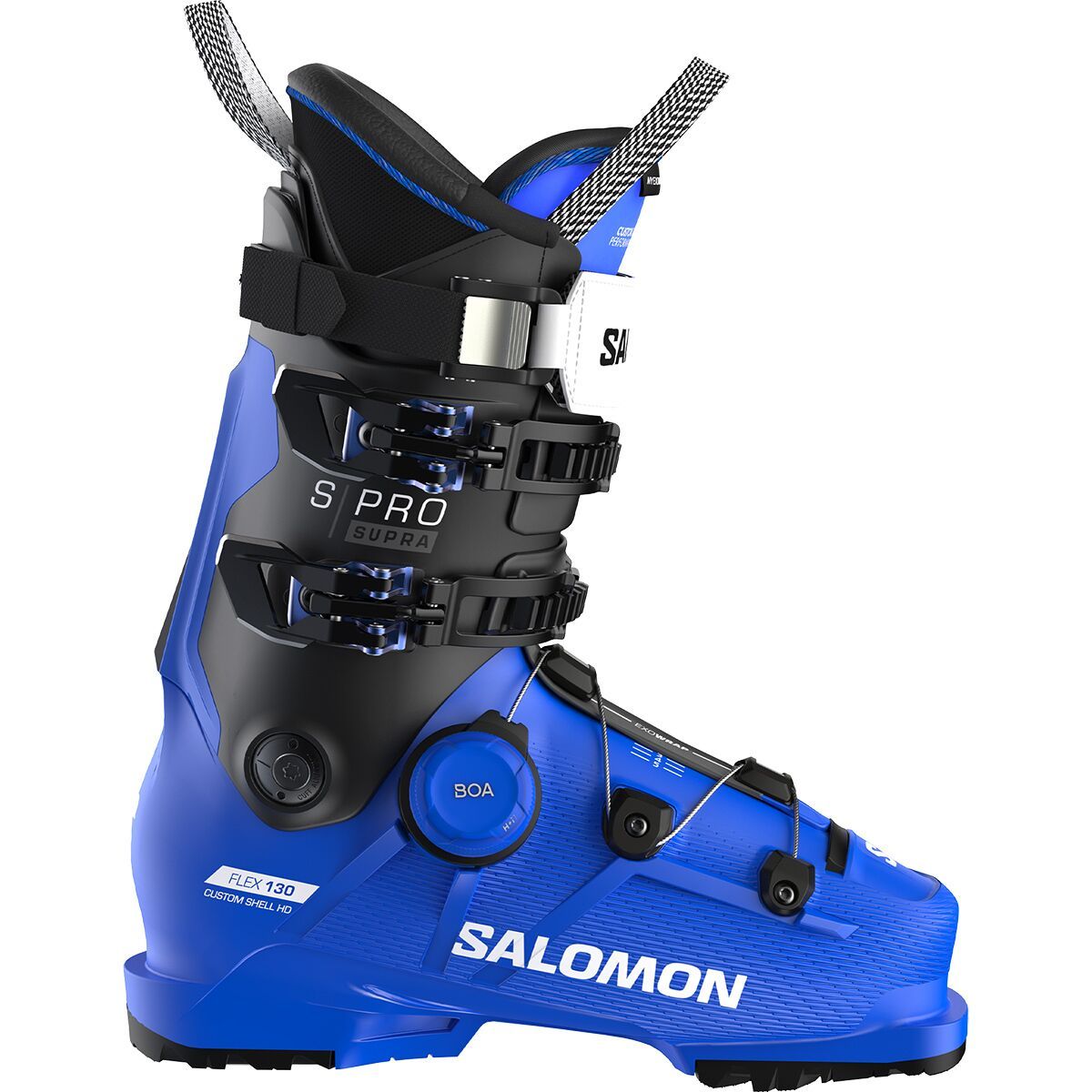
This is currently the most common hybrid setup and the one that’s taken over the all-mountain category. The lower shell (forefoot and instep area) uses a BOA dial and cable system, while the cuff retains two traditional buckles for independent leg closure.
The Salomon S/Pro Supra BOA is the flagship example here. Salomon’s EXOWRAP system routes the cable through integrated guides on both sides of the lower shell, creating that wrap-around closure pattern I described. Two aluminum micro-adjustable buckles on the cuff handle the leg.
What this solves: The high-instep problem. If you’ve ever dealt with that deep ache across the top of your foot from buckle pressure, this configuration addresses it directly. The cable distributes closure force across the entire lower shell rather than concentrating it at two buckle points. You get heel security without instep crushing.
The trade-off: You lose independent control of the toe zone versus the instep zone. With buckles, you could crank the instep for heel lock while leaving the toe area looser for circulation. With a single BOA dial controlling the entire lower shell, it’s a bit of all or nothing.
For most recreational skiers, this trade-off is worth it. For someone with a very specific need (say, a bunion on one side that needs more room while the other side needs to be snug), it can be limiting.
Examples and pricing:
- Salomon S/Pro Supra BOA 130 GW
- Salomon S/Pro Supra BOA 120 GW
- Salomon S/Pro Supra BOA 105 GW Women’s
- Fischer RC4 The Curv BOA 130
- Head Raptor R BOA 130
Configuration 3: BOA Cuff + Buckle Lower Shell
The reverse of Configuration 2. Buckles handle the forefoot and instep, while a BOA dial manages the cuff closure around the leg.
This is the rarest configuration, and one of the newest on the market.
What this solves: Calf fit issues. If you have thin calves that create a gap inside the cuff (leading to sloppy lateral response), the BOA cuff’s wrap-around closure and micro-adjustability can fill that gap more precisely than a buckle. The 4:1 gear ratio means you can incrementally tighten until the cuff is snug without the “one notch too loose, next notch too tight” buckle problem.
The trade-off: You keep independent buckle control over the forefoot and instep (good for managing specific pressure points), but you lose the pressure-distribution benefits of BOA in the lower shell, which is where most fit problems actually live.
Examples: Nordica Speedmachine 3 130 Cuff BOA Ski Boot – 2026

Configuration 4: Dual BOA (Zero Buckles)
Two BOA dials, no buckles at all. One dial controls the lower shell, the other controls the cuff. This is the newest and most aggressive configuration, and it’s where the marketing hype is loudest.
K2 led the charge with the Recon and Cortex lines. Salomon followed with the S/Pro Supra Dual BOA. Atomic has the Hawx Ultra Dual BOA. Head’s Kaliber is another player.
What this solves: If you want maximum pressure distribution everywhere, and you want the simplest possible on-snow adjustment experience, dual BOA delivers. Two dials, infinite micro-adjustment in both zones, even pressure wrap top to bottom. Some dual BOA models also offer the widest last ranges on the market. The Salomon S/Pro Supra Dual BOA, for example, spans 100mm to 106mm across its lineup, which is a massive range that accommodates foot shapes that would traditionally need separate narrow and wide models.
The trade-offs (and there are real ones):
First, no memory setting. With buckles, you set them once and they stay. You click in, your boot feels the same as yesterday. BOA dials reset when you release them.
Every time you put your boots on, you’re dialing in from scratch. For recreational skiers who just want to twist and go, this is fine. For racers and high-level skiers who want their boots to feel identical every run without thinking about it? It’s a dealbreaker.
Second, loss of all zone independence. A dual BOA gives you two zones (lower shell and cuff) instead of four. You can’t independently adjust the toe area versus the instep, or the lower calf versus the upper calf.
For most people, this simplification is a feature, not a bug. But if your fit requires specific zone-by-zone tuning, it’s a meaningful limitation.
Third, entry and exit. Getting into a dual BOA boot requires fully releasing both dials, and the shell doesn’t spring open the way it does when you pop buckles. It’s a different motion.
Not harder, exactly, but different. Some people find it less intuitive.
Examples: K2 Recon BOA, K2 Cortex, Salomon S/Pro Supra Dual BOA 130 (shown below), Atomic Hawx Ultra Dual BOA, Head Kaliber.

Price range: $500 to $750, with a roughly $50 to $100 premium over buckle equivalents in the same boot family.
The Bootfitter’s Honest Take: What BOA Changes About Fit
I’ve been sizing up these boots for a while now, and here’s what I think matters most.
The instep revelation is real. For skiers who have dealt with chronic instep pain from buckles, BOA lower shell closure is the single biggest improvement in boot closure in years. The wrap vs. clamp distinction isn’t marketing fluff.
If you have a high instep relative to your foot width, a BOA lower shell configuration should be at the top of your list.
The “8% more volume reduction” claim needs context. BOA and some brands claim the cable system reduces internal volume more effectively than buckles. In my experience, this is partially true, but it’s nuanced.
The cable does pull the shell inward more uniformly, which can reduce dead space (especially around the instep). But volume reduction is only helpful if it’s reducing dead space, not compressing your foot. An aggressive BOA tightening on a foot that’s already filling the shell will create pressure just like an aggressive buckle. The tool changed; the physics of squeezing a foot into a plastic shell didn’t.
Durability is actually a strength. This surprises people, but BOA hardware is screwed onto the shell (not riveted like buckle bails), which makes it easier to replace if something breaks. And the cable itself is rated at 550 pounds of breaking strength with a lifetime warranty from BOA. I’ve heard concerns about cable routing getting packed with snow, and that does happen occasionally, but a quick brush-out solves it. Buckle bails break too, and finding the right replacement bail for a specific boot model is often harder than swapping a BOA dial.
One thing nobody talks about: shell modification constraints. If you need a shell punch (where a bootfitter heats the plastic and presses it outward to make room for a bone spur or bunion), the BOA cable routing adds a new consideration. The cable guides are fixed points on the shell, and punching near a guide can compromise the closure system. A skilled bootfitter can work around this, but it’s an additional constraint that doesn’t exist with buckles. If you know you’ll need significant shell work, talk to your fitter about how the cable routing affects their options.
Which Configuration Fits YOUR Feet?
This is the part where things get personal, because the right closure system depends entirely on your specific foot dimensions. Here’s a framework based on the fit problems I see most often.
“I have a high instep and buckles always crush the top of my foot.”
Go with: BOA lower shell + buckle cuff (Configuration 2)
This is the configuration that was essentially designed for you. The cable wraps around the lower shell and distributes pressure across multiple points instead of concentrating it on the instep. Boots like the Salomon S/Pro Supra BOA or the Fischer RC4 The Curv BOA are strong options here.
“I have thin calves and my cuff always feels sloppy.”
Go with: BOA cuff + buckle lower, or Dual BOA (Configuration 3 or 4)
The BOA cuff’s 4:1 gear ratio lets you incrementally tighten until the cuff wraps your calf without gaps. The micro-adjustability matters more here than with buckles, where you’re often stuck between “too loose” and “too tight.”
“I have wide feet and struggle to find boots that don’t pinch.”
Go with: BOA lower shell or Dual BOA (Configuration 2 or 4)
The wrap-around closure of a BOA lower shell tends to accommodate width more naturally than buckles. And some dual BOA models (like the Salomon S/Pro Supra Dual BOA) offer last widths up to 106mm, which is wider than most traditional buckle boots in comparable performance tiers.
“I’m a racer or high-level skier who needs repeatable, zone-specific settings.”
Stick with: Traditional four-buckle (Configuration 1)
Not because BOA can’t perform at that level (the pressure mapping data suggests it can), but because the lack of memory settings and reduced zone independence creates friction for skiers who need their boots to feel identical every single run without thinking about it. There’s a reason the World Cup hasn’t adopted BOA despite the performance data. When milliseconds matter and your muscle memory is calibrated to a specific feel, “dial it in fresh each time” is a non-starter.
“I just want the simplest possible boot experience.”
Go with: Dual BOA (Configuration 4)
Two dials, no buckles, no overthinking. Twist until snug, ski, adjust on the fly if needed. If you’re not chasing podiums and you value convenience and even pressure distribution over zone-specific control, dual BOA is the most user-friendly closure system on the market right now.
Here’s the Problem with Choosing from Spec Sheets
I’ve just walked through four configurations, five foot shape scenarios, and a dozen specific boot models. And here’s what I haven’t been able to tell you: which boot actually fits YOUR foot.
A “100mm last” on a Salomon S/Pro Supra BOA and a “100mm last” on a K2 Cortex are going to fit differently. The shape of the toe box is different. The instep height is different. The heel pocket is different.
And that 100mm measurement? It’s only 100mm in one specific size (26.5 Mondo). If you wear a 24.5, the actual width might be closer to 96mm. If you wear a 29.0, it could be 104mm.
That’s how last width actually works, and it trips up a lot of people.
Add closure system on top of width, flex, volume, and last shape, and you’re looking at a staggering number of variables. This is exactly why picking boots from a spec comparison chart is so frustrating. A 100mm last, a 130 flex, and a BOA closure could describe twenty different boots that feel nothing alike on your foot.
The only way to cut through that noise is to start with your actual foot shape. That’s what Wayfinder’s 3D scan does: it captures your foot’s length, width, instep height, and volume, then matches those dimensions against how boots actually fit (not just what the spec sheet says).
When you know your exact instep height, forefoot width, and calf dimensions, the “which closure system” question gets a lot simpler. Because you’re not guessing which configuration might solve your fit problem. You’re matching your specific anatomy to the boots designed for it.
So, Is BOA Worth It?
Yes, with a caveat.
BOA is a legitimate advancement in ski boot closure technology. The pressure distribution improvements are real, especially in the lower shell. The micro-adjustability is a genuine convenience upgrade.
The durability is solid. And for specific foot shapes (high instep, thin calves, wide feet), BOA configurations can solve fit problems that buckles have always struggled with.
But it’s not a universal upgrade. If you have an “average” foot shape and traditional buckles have always worked fine for you, BOA doesn’t automatically make your boot fit better. And if you need maximum zone independence or repeatable settings without daily dialing, buckles still win.
The closure system is one piece of the puzzle. The shell shape, the last width at your specific size, the flex, the liner, the footbed… all of that matters just as much, if not more.
Don’t choose a boot for its closure system. Choose a boot for your foot, and let the closure system be one factor in that decision.
Not everyone has a bootfitter down the street to walk them through all of this. That’s why we built Wayfinder. Get your feet scanned, see which boots actually match your dimensions, and then decide whether buckles, single BOA, or dual BOA makes sense for your specific fit.
Internal Links:
- Ski Boot Last Width Explained: 98mm vs 100mm vs 102mm
- How Tight Should Ski Boots Be?
- The Most Exciting Ski Boots for 2025/2026
- The Complete Anatomy of a Ski Boot
- Ski Boots for Wide Feet
Your Digital Ski Bootfitter
Find BOA boots that fit your foot, not just your aesthetic.
Wayfinder scans your feet and identifies which BOA and buckle boots are built for your width and volume. Free, 5 minutes, just your phone.
Start My Free FittingFAQ
Yes, with a caveat. The pressure distribution improvements are real, especially in the lower shell, the micro-adjustability is a genuine convenience upgrade, and the durability is solid. But it is not a universal upgrade: if you have an average foot shape and buckles have always worked for you, BOA does not automatically make a boot fit better. Choose a boot for your foot first, and treat the closure system as one factor in that decision.
Buckles press down at a few fixed contact points, while a BOA dial tightens a stainless steel cable that wraps the shell inward from five or more points at once. Think clamp versus wrap. BOA’s published testing found a 13% reduction in peak foot pressure compared to buckles, and the dial gives 1mm micro-adjustments with no notches. Buckles still win on independent zone control and repeatable settings, which is why racers stick with them.
Yes, these are the foot shapes BOA helps most. If buckles crush the top of your foot, a BOA lower shell distributes closure force across the whole forefoot instead of concentrating it at two points, so you get heel security without instep pain. For wide feet, the wrap-around closure accommodates width more naturally, and some dual BOA models like the Salomon S/Pro Supra Dual BOA span last widths from 100mm to 106mm.
A single BOA setup usually pairs a BOA dial on the lower shell with two buckles on the cuff; dual BOA uses two dials and no buckles at all. Dual BOA gives maximum pressure distribution and the simplest adjustment experience, but the dials reset every time you release them, so there is no memory setting, and you drop from four adjustment zones to two. The single BOA hybrid remains the most common configuration.
Because BOA dials have no memory setting and less zone independence. Buckles stay where you set them, so the boot feels identical every run, and four buckles give four independently tunable zones. A dual BOA must be dialed in fresh each time and offers only two zones. When muscle memory is calibrated to a specific feel, that friction is a dealbreaker, which is why the World Cup has not adopted BOA despite the pressure-mapping data.
Yes, durability is actually a strength. The hardware is screwed onto the shell rather than riveted like buckle bails, which makes it easier to replace, and the cable is rated at 550 pounds of breaking strength with a lifetime warranty from BOA. Cable routing can occasionally pack with snow, but a quick brush-out solves it. One real constraint: shell punches near a cable guide need a skilled bootfitter, since the guides are fixed points on the shell.