
Lange put BOA on an overlap boot. Salomon rebuilt the ankle. And the dual BOA boots that headlined last season are sitting on shelves at 30% off. A certified bootfitter’s guide to the best ski boots of 2026/2027, and how to pick the one that fits YOUR feet.
This is an unusually good season to buy ski boots, for two reasons that have nothing to do with each other.
First, the headline releases changed real engineering. Lange’s Code brings BOA to the brand that defines the overlap boot. Salomon’s S/Pro Alpha C BOA rethinks how the cuff connects to the shell. K2 rebuilt the Anthem around women-specific shell molds.
Second, the boots that led this category a year ago are heavily discounted. The Salomon Shift Alpha BOA 130 is down from $999.95 to $699.96. K2’s Recon 130 BOA dropped from $899.95 to $629.96. These were the most exciting boots on the wall twelve months ago, and they ski exactly as well today.
I’ll walk through what’s new, what’s discounted, and how to figure out which of these boots is actually built for your foot. Prices and availability below are from Backcountry as of August 31, 2026, and will move as the season ramps up.
Table of contents
- What’s Actually New for 2026/2027?
- Lange Code: BOA Finally Meets the Overlap Boot
- Salomon S/Pro Alpha C BOA: The Rebuilt Ankle
- K2 Anthem: The Women’s Rebuild (and the Sale on the Current One)
- Head Kaliber Pro LV: Both Dials on the Cuff
- Last Season’s Best Boots Are Up to 30% Off
- Understanding Ski Boot Fit: Volume, Last Width, and What Actually Matters
- Boot Recommendations by Skier Type
- The Bottom Line: Buy Early This Season
- Frequently Asked Questions
What’s Actually New for 2026/2027?
Four launches define this season, and I covered the engineering behind each of them in detail in my 2026/2027 season preview. The short version, updated now that boots are hitting shelves:
- Lange Code (in stock now). BOA closure and a re-engineered walk mode on a platform that evolves the XT3 series. Full lineup from a 95 flex women’s model to a 140 flex with RECCO.
- Salomon S/Pro Alpha C BOA (in stock now). Replaces the traditional inside ankle pivot with a bolted Powerlink plate, with BOA on the cuff instead of the forefoot. The most mechanically interesting boot of the year.
- K2 Anthem rebuild (arriving this fall). Purpose-built women-specific shell molds instead of scaled-down men’s designs. Meanwhile the outgoing Anthem BOA is discounted 30%.
- Head Kaliber Pro LV (limited distribution). Both BOA dials on the cuff, cables routed down to close the lower shell. Bold, and hard to find at retail so far.
Under all four is the same question. How do you get a boot to wrap your foot and leg precisely without crushing it? Each brand is attacking it from a different angle, which makes fit more important this year, not less. A clever closure system on the wrong last is still the wrong boot.
Lange Code: BOA Finally Meets the Overlap Boot
While other brands rushed BOA onto their performance boots over the last two seasons, Lange held back and let the XT3 series ride on traditional buckles. The Code is what they were working on instead.
It pairs BOA closure with a re-engineered external walk mode, GripWalk soles, and tech binding compatibility, aimed squarely at the all-mountain and freeride skier who wants one boot for everything.
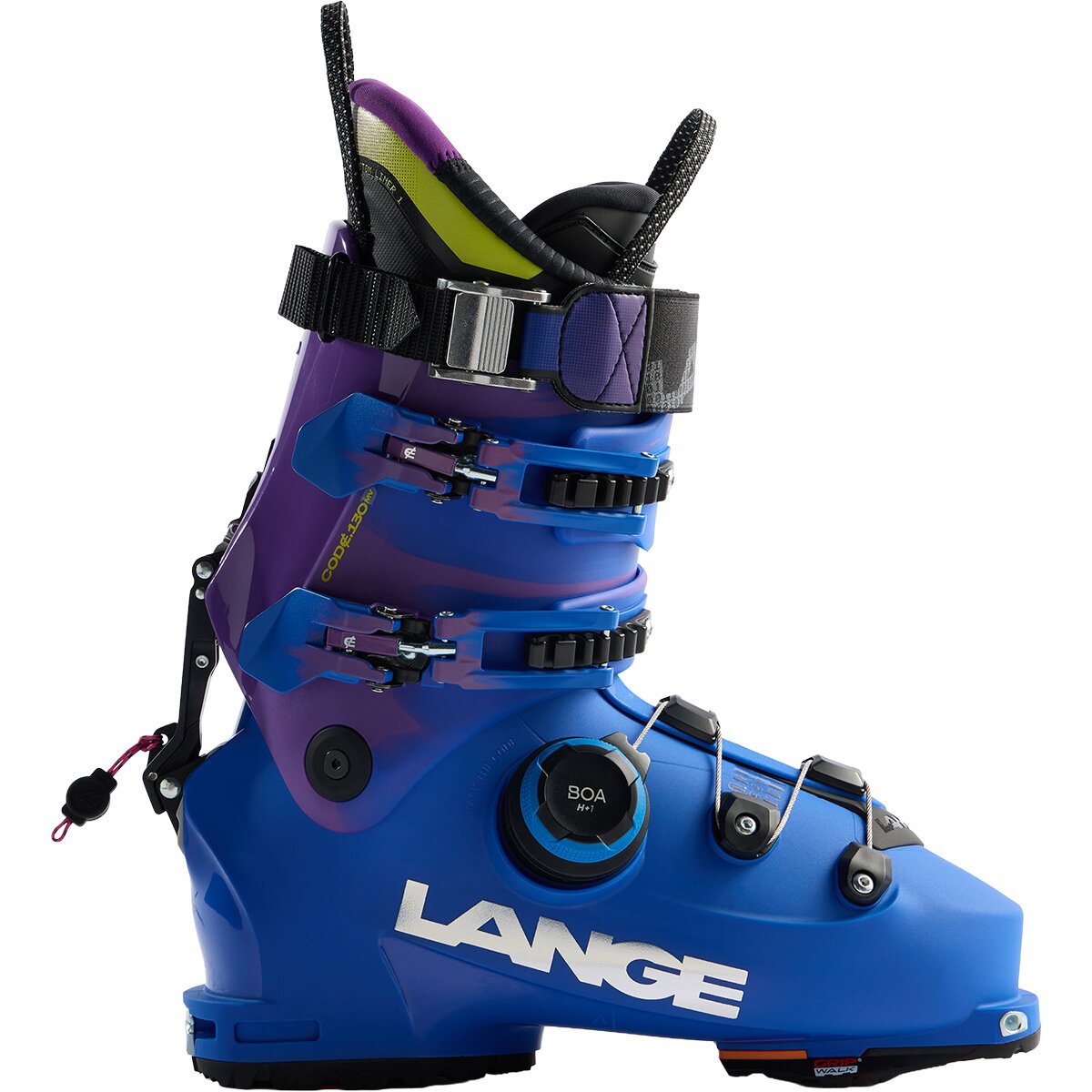
Why it took this long: Lange’s reputation is built on precision and feel, and their Shadow and RS lines set the standard they had to meet. Rather than retrofit dials onto an existing mold, they spent extra R&D cycles on how BOA integrates with their shell construction. Whether that patience produces a noticeably better BOA experience than the retrofits is the question I’ll be testing this winter, but the spec sheet is serious. The 140 flex version even carries RECCO reflectors for skiers pointing it off-piste.
What’s available now:
- Lange Code 130 LV BOA GW (97mm last) at $1,099.95
- Lange Code 130 MV BOA GW (100mm last) at $1,099.95
- Lange Code 140 LV BOA GW at $1,149.95 for the strongest skiers
- Lange Code 115 LV BOA GW Women’s at $999.95
- Lange Code 95 MV BOA GW Women’s at $849.95
Who it’s for: Advanced and expert skiers who want overlap-boot power with dial-in convenience, and anyone who was waiting for BOA to show up on a boot with real freeride credentials. If the Shadow’s Suspension Blade design intrigued you but you wanted a walk mode and tech inserts, the Code is that boot.
Salomon S/Pro Alpha C BOA: The Rebuilt Ankle
Most ski boots connect the cuff to the lower shell with a pivot on each side of your ankle, and it’s been that way since the two-piece overlap boot was introduced decades ago. Salomon kept the outside pivot and eliminated the inside one.
The cuff now extends below the ankle and bolts to the lower shell through a Powerlink plate just above the sole. Salomon’s claim for this ExoDrive construction is that the boot flexes as one unified piece rather than two pieces hinging at your ankle.
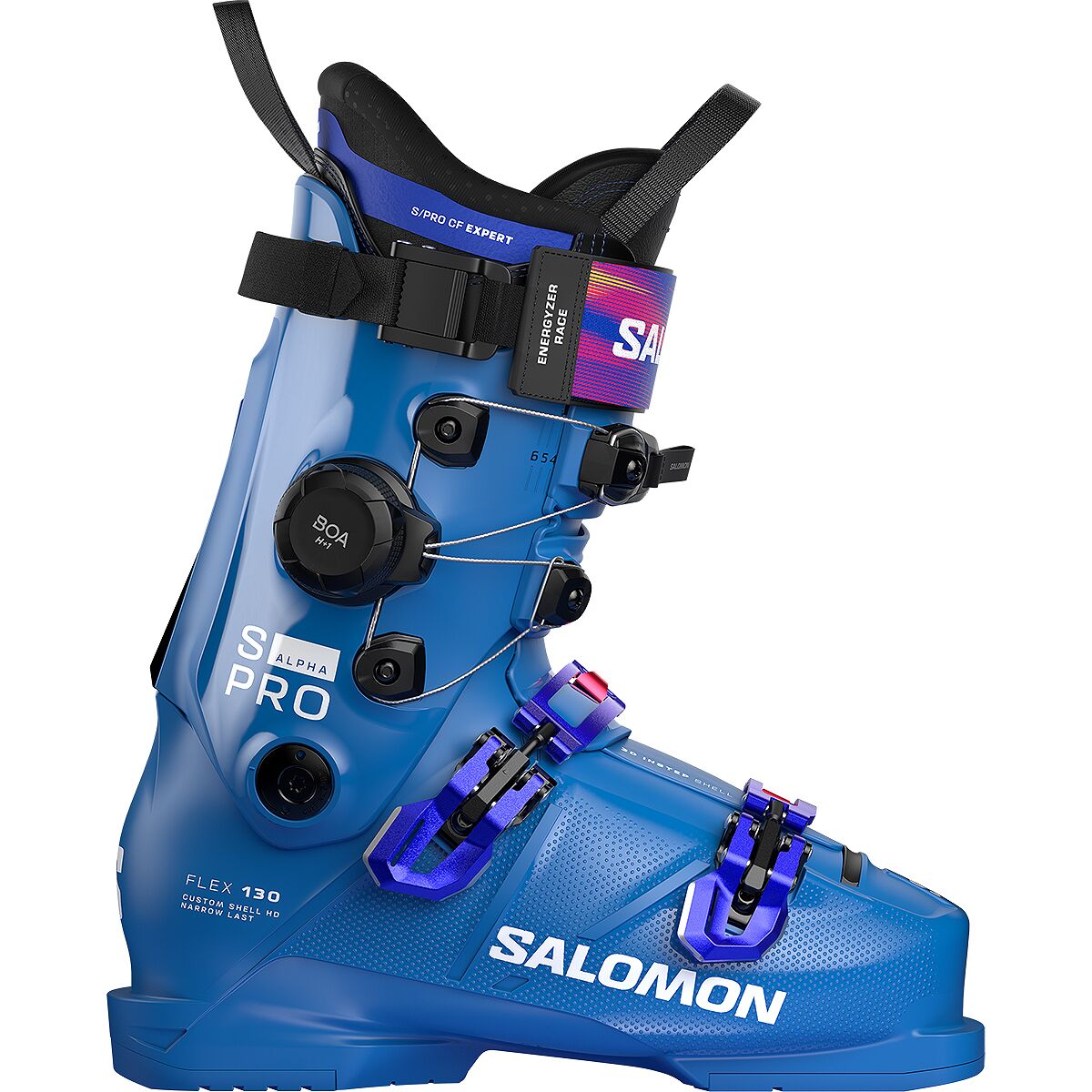
The fit story: Early tester feedback has been notably positive on heel retention. The extended cuff wrap creates strong heel lock without the painful clamping that low-volume boots sometimes deliver. The BOA placement is also backwards from most of the market, on the upper cuff rather than the lower shell, with two buckles handling the forefoot. Salomon’s logic is that the cuff is where micro-adjustable pressure matters most.

What’s available now:
- Salomon S/Pro Alpha C 130 BOA (98mm last) at $899.95
- Salomon S/Pro Alpha C 95 BOA Women’s at $649.95
Who it’s for: Lower-volume feet that struggle with heel lift. A 98mm last is narrow, so if you’ve measured wide or even solidly medium, look elsewhere on this list. If you’re not sure what your forefoot actually measures, that’s exactly the number a 3D scan pins down before you spend $900.
K2 Anthem: The Women’s Rebuild (and the Sale on the Current One)
Most women’s ski boots are scaled-down men’s molds with softer flex and different colors. I’ve written about what’s actually different in women’s boots, and shell shape mostly isn’t on the list.
K2’s Anthem rebuild for 2026/2027 changes that with purpose-built women-specific molds. Narrower heels paired with wider toe boxes, steeper internal ramp angle, more forward lean, a new calf adjustment mechanism, and sizes down to 21.5. Designed by women, for women.
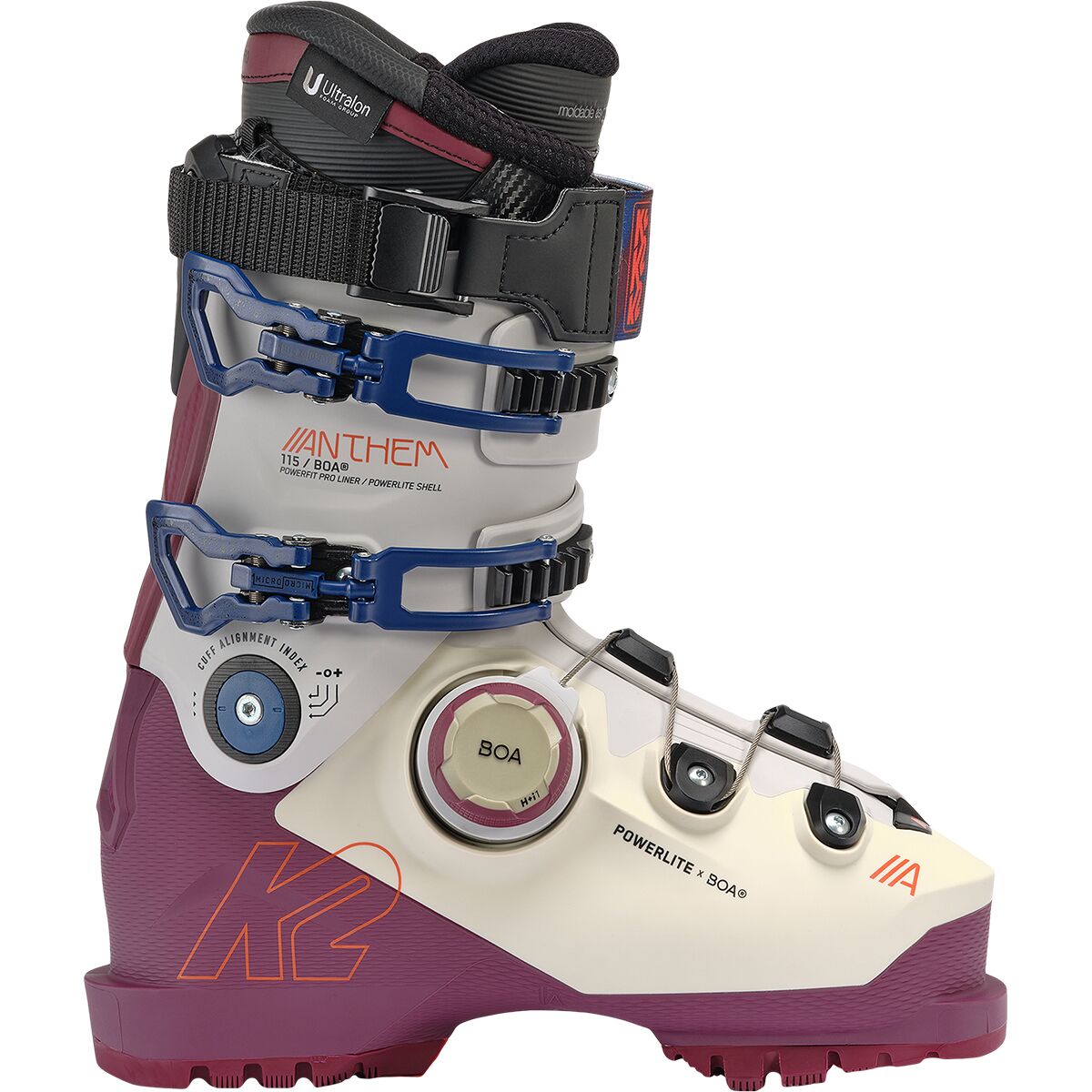
The rebuilt Anthem arrives at retail this fall. In the meantime, the outgoing Anthem BOA is one of the best women’s values on the wall right now:
- K2 Anthem 105 BOA at $559.96, down from $799.95
- K2 Anthem 115 BOA at $629.96, down from $899.95
Who it’s for: Strong women skiers who want zonal BOA fit without paying launch-season prices, or anyone whose heel-to-forefoot proportions never worked in unisex shells. If the rebuild delivers on its geometry claims, it will be worth the wait; I’ll update this guide once I’ve seen production boots.
Head Kaliber Pro LV: Both Dials on the Cuff
Head’s current Kaliber MV was one of the most talked-about dual BOA boots of last season, and the new Kaliber Pro LV doubles down by moving both dials to the upper cuff, routing cables down to close the lower shell from above. The reasoning is practical. A dial mounted low on the shell is exposed at extreme edge angles, and shearing one off mid-run ends your day.
The Pro LV sits on a 98mm last with a bi-injected shell, stiff in the spine and softer over the forefoot where the wrap happens.
Distribution is the catch. This boot is not currently carried by our retail partner, so if you want one you’ll be hunting specialty shops. I break down the full engineering, and what I’m watching for when it goes on feet, in the season preview.
Last Season’s Best Boots Are Up to 30% Off
The 2025/2026 season brought the biggest wave of boot design changes in years, dual BOA above all, and those boots are now discounted while remaining current designs. A boot that was a category leader twelve months ago doesn’t ski any worse because a newer sibling exists.
The standout deals right now:
- Salomon Shift Alpha BOA 130 at $699.96, down from $999.95. A 130-flex freeride boot with hybrid touring capability at 30% off.
- K2 Recon 130 BOA at $629.96, down from $899.95. K2’s all-mountain BOA charger.
- Tecnica Mach1 MV 130 at $637.49, down from $849.99. The benchmark traditional overlap boot, no dials required.
- K2 Anthem 115 BOA Women’s at $629.96, down from $899.95.
Carryovers still worth full price:
- Atomic Hawx Ultra Dual BOA, still the reference point for dual-dial fit on a narrow last
- Lange Shadow 130 MV, whose Suspension Blade design remains the power-transfer boot to beat, also in LV and HV at $1,049.95
- Armada AR One 130 MV at $849.95
- Nordica Speedmachine 3 130 Cuff BOA
- Fischer RC4 Pro LV BOA ZipFit at $1,099.95, the only boot here that ships with a ZipFit cork liner
- K2 Mindbender 130 BOA at $999.95 for the 50/50 resort-and-touring crowd
- Dalbello Cabrio LV 130 at $779.99, the three-piece cabrio design refined
- Tecnica Cochise 130 at $849.99 for freeride days
Sale stock has one catch, and it’s sizes. Discounted boots sell through the common sizes (26.5 to 28.5) first, and by mid-winter the leftovers cluster at the ends of the range. If a deal above matches your foot, move on it early.
Understanding Ski Boot Fit: Volume, Last Width, and What Actually Matters
All the technology in the 2026/2027 lineup won’t help if the boot doesn’t fit your foot. Last width (the boot’s internal forefoot measurement in mm) is the starting point, but instep height, heel pocket depth, calf volume, and toe box shape also determine fit. Two boots with identical 100mm lasts can feel completely different because of these other dimensions, which is why 3D foot scanning provides more accurate matching than size charts alone.
Last Width Explained
Last width is the measurement across the widest part of the boot’s forefoot, expressed in millimeters:
- Narrow (97-98mm): For narrow feet. These boots fit snugly and prioritize precision. The Code LV, Alpha C, and Kaliber Pro LV all live here.
- Medium (99-101mm): The most common category, designed for “average” feet. Significant variety exists within this range.
- Wide (102-103mm): For wider feet and square toe profiles.
- Extra Wide (104mm+): For the widest feet, where most mainstream lasts run out of room.
Those bands describe width only. Volume is a separate dimension, the room the shell has over your instep and around your heel, and two boots built on the same last can differ noticeably in it. That is why a boot can feel tight across the top of your foot even when the width is right. I dig into that in ski boot volume explained.
Read more about ski boot lasts here.
Beyond Width: Other Fit Factors
Last width is just the starting point. Other critical dimensions include:
- Instep height: How much room exists over the top of your foot
- Heel pocket depth: How well the boot locks your heel in place
- Calf volume: How the upper cuff fits your lower leg
- Toe box shape: Pointed vs. squared-off
Two boots with identical 100mm lasts can fit completely differently depending on these other factors.
Why Your Foot’s 3D Shape Matters
Traditional boot sizing focuses on length and width, but feet are three-dimensional, and that third dimension often determines whether a boot feels perfect or painful.
This is where modern foot scanning technology becomes invaluable. By capturing the complete 3D profile of your foot, including arch height, instep volume, heel shape, and toe configuration, digital bootfitting tools can match you with boots that accommodate your specific anatomy.
Wayfinder’s foot scanning technology captures a detailed 3D model of your feet using just your smartphone and matches you with boots that actually fit your individual shape, not just your length and width. This is particularly valuable when shopping online, where you can’t physically try on multiple boots. Instead of guessing based on size charts, you get recommendations based on how your feet actually compare to each boot’s internal shape.
Get started with your fit here.
Boot Recommendations by Skier Type
For All-Mountain Chargers
If you’re skiing everything the mountain offers (groomers, bumps, trees, the occasional hike-to line), prioritize:
- Stiff to moderate flex (115-130 for experts, 100-115 for advanced)
- Medium volume for versatility
- BOA if you value mid-day micro-adjustments
Top picks: Lange Code 130 MV BOA, Lange Shadow 130 MV, Tecnica Mach1 LV 130
For Freeride and Big Mountain Skiers
Powder days, steep terrain, and variable conditions demand boots with power transfer and forgiveness:
- True stiff flex (120-130)
- Progressive flex patterns that absorb impacts
- Compatibility with hybrid touring bindings is a plus
Top picks: Salomon Shift Alpha BOA 130 (on sale), Tecnica Cochise 130, K2 Mindbender 130 BOA, Lange Code 140 LV BOA if you want the walk mode with maximum stiffness
For Narrow, Low-Volume Feet
Heel lift and sloppy midfoot fit are the usual complaints. Look for 97-98mm lasts and strong heel pockets:
Top picks: Salomon S/Pro Alpha C 130 BOA, Lange Code 130 LV BOA, Fischer RC4 Pro LV BOA ZipFit
For Women Who Want a Boot Built for Them
Between K2’s rebuild, Lange’s women’s Code lineup, and Salomon’s women’s Alpha C, this is the strongest women’s flagship class in years:
Top picks: K2 Anthem 115 BOA (on sale now, rebuild landing this fall), Lange Code 115 LV BOA, Salomon S/Pro Alpha C 95 BOA
For Intermediate Skiers Ready to Progress
You don’t need a 130 flex, and this season you don’t need a full-price boot either. A 100-115 flex in the right last will do more for your skiing than any flagship:
Top picks: K2 Anthem 105 BOA (on sale), Lange Code 95 MV BOA Women’s, and check my beginner and budget guide for the full value picture. Not sure what flex you need? The flex calculator answers that in a minute.
The Bottom Line: Buy Early This Season
Normally the smart play is waiting for spring sales. This season the calculus is different. The new flagships just shipped and won’t see meaningful discounts before late season. The last-generation BOA boots are already discounted 25-30%, and that inventory is finite. The best value window for a current-design boot is right now, before the common sizes sell through.
Whichever direction you go, the order of operations matters. Fit first, features second, price third. Scan your feet, find out which lasts match your dimensions, and then shop this list knowing which boots are actually candidates.
Frequently Asked Questions
The strongest new releases are the Lange Code 130 BOA for all-mountain skiers, the Salomon S/Pro Alpha C 130 BOA for narrow feet that fight heel lift, and K2’s rebuilt Anthem for women arriving this fall. The best values are last season’s leaders on closeout, led by the Salomon Shift Alpha BOA 130 at 30% off. The best boot for you depends on your foot shape more than any ranking.
If a discounted 2025/2026 boot matches your foot shape and skiing style, buy it without hesitation. These are current designs at 25-30% off, and boot technology doesn’t turn over fast enough to make a one-year-old flagship obsolete. Pay full price when a new boot solves a fit problem the old one can’t, like the Alpha C’s heel retention or the Anthem rebuild’s women-specific molds.
BOA boots typically cost 20-40% more than comparable buckle models. The dials distribute pressure more evenly and allow glove-on micro-adjustments, which matters most for high insteps and irregular foot shapes. Traditional buckles remain a proven system, and boots like the Tecnica Mach1 show how good a buckle boot still is. My BOA explainer covers the configurations in detail.
Flex depends on your weight, height, ability, and skiing style, not your ego. Most advanced men land between 110 and 130, most advanced women between 95 and 115, and intermediates should go softer. Use the flex calculator to get a number based on your actual inputs, and read the flex guide to understand why brand ratings aren’t standardized.
Measure before you shop. Last width, instep height, and heel shape decide fit, and none of them show up in a product photo. Wayfinder’s free 3D scan captures your foot dimensions from your phone and matches them against how these boots actually fit inside, so you start from the two or three boots built for your shape instead of guessing from a wall of ten.